
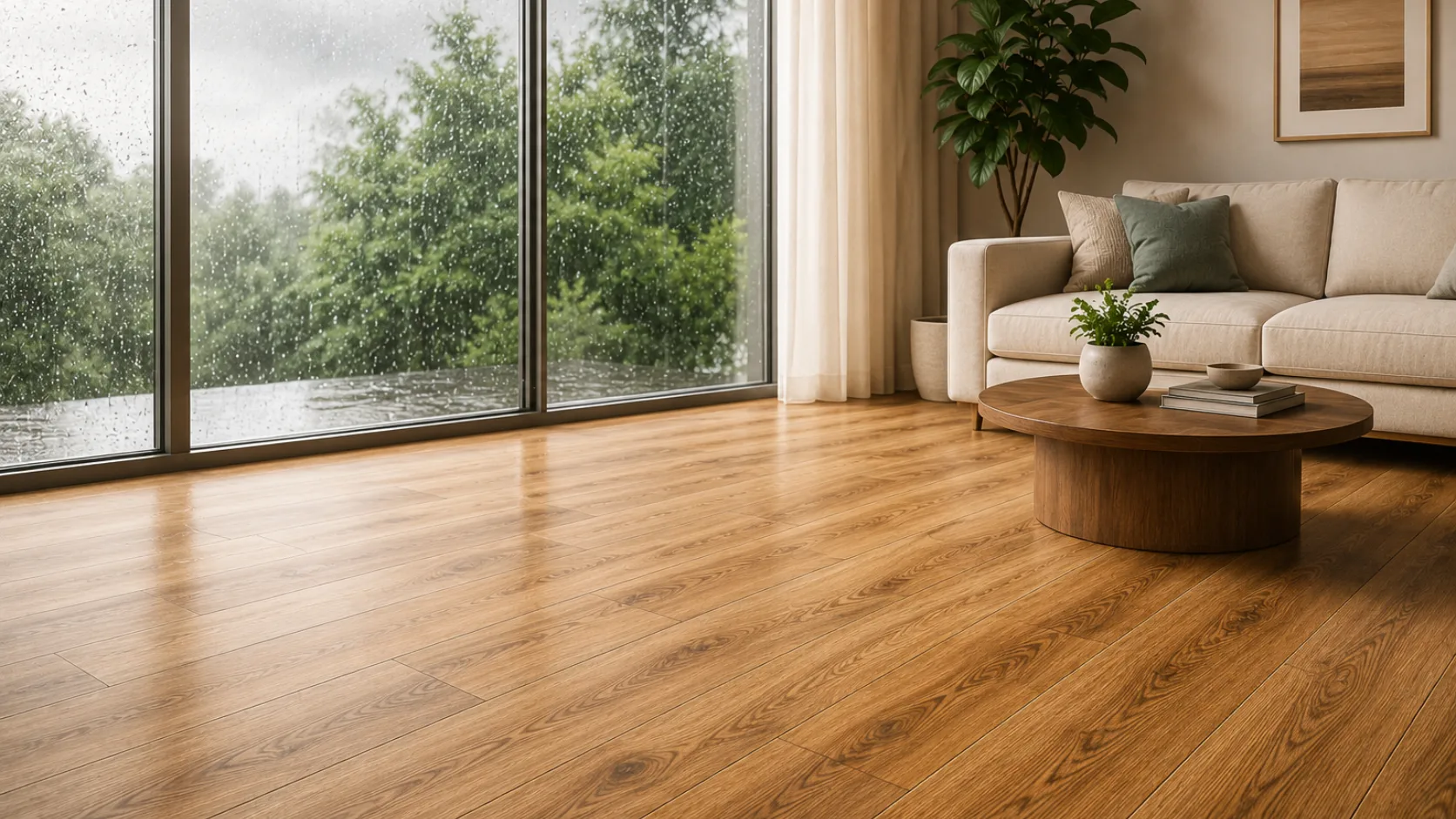
If you’ve ever watched a beautiful hardwood floor start cupping at the edges the first monsoon after installation, you already know the problem. India isn’t one climate — it’s four or five stacked on top of each other, and most flooring advice you’ll find online is written for temperate countries where humidity swings by 10-15% a year, not 40-60% like it does in Mumbai or Ahmedabad between April and August.
This guide breaks down what actually happens to wooden flooring in India across seasons, which materials hold up, and how to choose flooring that won’t warp, gap, or peel in year two. It’s written from real installation experience across Indian homes — not translated from a US or European flooring Post.
The best wooden flooring for the Indian climate is Engineered Wood Flooring or High-Quality Luxury Vinyl Flooring (LVF/SPC). Both are dimensionally stable, resist humidity-driven expansion and contraction, and perform reliably through India’s monsoon, summer heat, and dry winters. Solid Hardwood Flooring can work well in low-humidity regions such as Rajasthan and Delhi-NCR, but it is generally less suitable for coastal and high-humidity cities like Mumbai, Chennai, Kochi, and Kolkata, where excess moisture may cause expansion, contraction, or warping over time.
For most Indian homes, Engineered Wood Flooring and Luxury Vinyl Flooring (SPC/LVF) provide the ideal balance of moisture resistance, durability, premium aesthetics, and low maintenance throughout every season.
Why Indian Climate Is So Tough on Wooden Flooring
Wood is hygroscopic — it absorbs and releases moisture from the surrounding air constantly. In climates with stable humidity, this isn’t a big issue. In India, it’s the single biggest cause of flooring failure.
The Three Climate Stressors
1. Monsoon Humidity (June–September) Relative humidity can spike to 80-95% in cities like Mumbai, Kolkata, and Chennai. Wood absorbs this moisture and expands. If it has nowhere to go, it cups, buckles, or pushes against walls and doorframes.
2. Peak Summer Heat (April–June) In North and Central India — Delhi, Ahmedabad, Nagpur — temperatures cross 42-45°C with very low humidity. This dries wood out rapidly, causing shrinkage, gapping between planks, and surface cracking.
3. Rapid Seasonal Swings The real damage isn’t heat or humidity alone — it’s the swing between them within the same year, sometimes within the same week during pre-monsoon storms. Wood that expands in July and contracts in May, year after year, eventually loses structural integrity at the joints.
Expert insight: At OAKA Floors, the flooring failures we’re called to inspect most often aren’t due to poor quality material — they’re due to material chosen for the wrong climate zone, or installed without an acclimatization period before laying.
Wooden Flooring Options for Indian Homes: Full Comparison
| Flooring Type | Humidity Resistance | Best Climate Zones | Lifespan | Price Range (per sq. ft.) | Maintenance |
|---|---|---|---|---|---|
| Solid Hardwood | Low–Moderate | Dry regions (Delhi-NCR winters, Rajasthan) | 20–30 yrs (if well maintained) | ₹450–₹900 | High |
| Engineered Wood | High | All zones, incl. coastal | 15–25 yrs | ₹250–₹550 | Moderate |
| Luxury Vinyl Flooring (LVF/SPC) | Very High | All zones, especially humid coastal cities | 15–20 yrs | ₹120–₹280 | Low |
| Laminate Flooring | Moderate | Dry to moderate humidity zones | 10–15 yrs | ₹80–₹180 | Low |
Prices are indicative market ranges and vary by finish, plank size, and installation complexity.
1. Solid Hardwood Flooring
Solid wood is a single piece of timber, milled and finished. It’s the most “natural” option and the most climate-sensitive.
Pros:
- Can be sanded and refinished multiple times
- Ages beautifully, adds long-term property value
- Best natural grain and depth
Cons:
- Expands/contracts significantly with humidity
- Not recommended for bathrooms, kitchens, or ground floors in coastal cities
- Requires strict acclimatization before installation
Best suited for: Delhi-NCR, Punjab, Rajasthan, and other low-to-moderate humidity zones — particularly upper floors, bedrooms, and living rooms away from direct monsoon moisture exposure.
2. Engineered Wood Flooring
This is the most balanced answer to “what’s the best wooden flooring brand or material for Indian conditions.” Engineered wood has a real hardwood top layer bonded over cross-layered plywood, which makes it far more dimensionally stable than solid wood.
Why it works in India:
- The cross-ply core resists the cupping and gapping solid wood is prone to
- Performs consistently in both monsoon humidity and summer dryness
- Available with real wood veneer, so it still looks and feels authentic
Pros:
- Stable across humidity swings
- Can be installed on all floor levels, including over concrete
- Wide design range — oak, walnut, teak finishes
Cons:
- Limited refinishing compared to solid wood (depends on veneer thickness)
- Slightly higher cost than laminate or vinyl
Best suited for: Mumbai, Bengaluru, Pune, Hyderabad, and wooden flooring Ahmedabad projects where homes see both heavy monsoon humidity and dry summer heat within the same year.
3. Luxury Vinyl Flooring (LVF/SPC)
Luxury vinyl flooring has become one of the fastest-growing flooring categories in urban India, and for good reason — it’s engineered specifically to be waterproof and dimensionally stable.
Why it’s gaining ground:
- 100% waterproof core (SPC — Stone Polymer Composite)
- Zero expansion/contraction issues from humidity
- Realistic wood-look finishes with texture-matched embossing
- Ideal for kitchens, bathrooms, balconies, and ground-floor spaces prone to dampness
Pros:
- Best humidity and water resistance of any wood-look flooring
- Lower cost than engineered or solid wood
- Easy click-lock installation, faster turnaround
Cons:
- Doesn’t offer the “real wood” resale premium some buyers look for
- Quality varies significantly between brands — wear layer thickness matters
Best suited for: Coastal and high-humidity cities — Mumbai, Chennai, Kochi, Kolkata — and any home with kids, pets, or high foot traffic.
Regional Flooring Guide: What Works Where in India
Coastal & High-Humidity Cities (Mumbai, Chennai, Kochi, Goa, Kolkata) Luxury vinyl flooring or engineered wood with a high-quality moisture barrier. Avoid solid hardwood on ground floors.
Hot & Dry Cities (Delhi-NCR, Jaipur, Ahmedabad, Nagpur) Engineered wood performs best due to the extreme summer-to-monsoon humidity swing. Solid hardwood is workable but needs careful acclimatization and a good underlay.
Moderate Climate Cities (Bengaluru, Pune, Hyderabad) All three options work well; the choice comes down to budget and design preference rather than climate risk.
Common Mistakes Homeowners Make (And How to Avoid Them)
- Skipping acclimatization — Wood flooring must sit in the room it’ll be installed in for 48-72 hours before laying, so it adjusts to local humidity and temperature.
- Ignoring the subfloor moisture level — Installing over a concrete slab that hasn’t fully cured traps moisture underneath, causing damage from below.
- No expansion gap — Wood needs a small gap at the walls to expand during monsoon. Tight installations are one of the top causes of buckling.
- Choosing based on photos alone — Wear layer thickness, core density, and finish quality vary hugely between suppliers; always ask for physical samples.
- DIY installation without proper tools — Flooring installation in India’s climate needs vapor barriers, correct adhesives, and expansion planning — this is where working with a professional wooden flooring installation services provider matters.
Installation & Maintenance Tips for Indian Conditions
Before Installation
- Get a moisture-meter reading of the subfloor
- Acclimatize planks in the actual room, not a warehouse
- Use a proper underlay/moisture barrier, especially on ground floors
During Monsoon
- Keep humidity indoors between 40-60% using dehumidifiers or AC if possible
- Wipe spills immediately — even water-resistant floors shouldn’t sit in standing water
- Avoid wet mopping; use a damp (not wet) microfiber mop
During Summer
- Avoid placing floors in direct, prolonged sunlight without UV-protective finishes
- Maintain some indoor humidity (a humidifier helps in very dry regions) to prevent excessive shrinkage
Ongoing Maintenance
- Reapply protective finish/polish as recommended by your flooring company every 2-3 years for solid/engineered wood
- Use furniture pads to prevent surface dents
- Avoid harsh chemical cleaners; use pH-neutral wood floor cleaners
How to Choose the Best Wooden Flooring Brand in India
When comparing brands, look past marketing claims and check:
- Core material and construction — cross-ply engineered cores outperform single-layer options in humidity
- Wear layer thickness (for vinyl) — anything below 0.3mm wears out faster in high-traffic Indian homes
- AC (Abrasion Class) rating for laminate and vinyl — higher AC ratings mean better durability
- Warranty terms — a brand confident in humidity performance will offer a clear warranty against warping
- Local climate testing — ask if the product has been tested or used in similar humidity conditions to your city
- Installation support — a reliable wooden flooring company should offer site inspection, moisture testing, and professional laying, not just product delivery
OAKA Floors works across these categories — engineered wood, solid wood, and luxury vinyl flooring — with product selection guided by the client’s city and room-level humidity exposure, rather than a one-size-fits-all recommendation. For projects in wooden flooring Ahmedabad and other high-swing climate zones, this climate-first approach is what determines whether a floor lasts 5 years or 25.
Cost of Wooden Flooring in India (2026 Market Snapshot)
| Flooring Type | Approx. Cost (Material + Installation) |
|---|---|
| Laminate | ₹100–₹220 per sq. ft. |
| Luxury Vinyl Flooring | ₹150–₹320 per sq. ft. |
| Engineered Wood | ₹300–₹650 per sq. ft. |
| Solid Hardwood | ₹500–₹1,100 per sq. ft. |
Actual costs depend on plank thickness, finish quality, subfloor prep, and city-specific labor rates.
Conclusion
Choosing wooden flooring in India isn’t about picking the most attractive plank in a showroom — it’s about matching the material to how your city’s climate actually behaves across the year. Engineered wood and luxury vinyl flooring consistently outperform solid hardwood in humidity-heavy and high-swing climates, while solid wood remains a strong option in drier regions when installed correctly.
If you’re planning a flooring project and want a recommendation based on your specific city, home orientation, and budget, OAKA Floors can help you compare engineered wood, solid wood, and luxury vinyl flooring options suited to your local climate — with professional installation support from site assessment to finishing. Get in touch with OAKA Floors to discuss the right flooring for your space.
FAQ Section
Q: Which wooden flooring is best for humid climates in India?
A: Engineered wood and luxury vinyl flooring are best for humid Indian climates because their layered, cross-grain construction resists the expansion and contraction that causes solid wood to warp.
Q: Can solid wood flooring be used in Mumbai or coastal cities?
A: It’s possible on upper floors away from direct moisture, but it’s generally not recommended for ground floors or bathrooms in coastal cities due to consistently high humidity levels.
Q: Is luxury vinyl flooring as good-looking as real wood?
A: Modern luxury vinyl flooring uses high-resolution printing and embossed texture to closely replicate real wood grain, and most people can’t tell the difference from a few feet away.
Q: How long does wooden flooring last in Indian conditions?
A: With correct material choice and installation, engineered wood typically lasts 15-25 years, solid hardwood 20-30 years, and luxury vinyl flooring 15-20 years.
Q: Does wooden flooring need special care during monsoon?
A: Yes — maintaining indoor humidity between 40-60%, wiping spills immediately, and avoiding wet mopping are essential during monsoon months.
Q: What is the difference between engineered wood and laminate flooring?
A: Engineered wood has a genuine wood veneer top layer, while laminate uses a printed image layer under a protective coating — engineered wood offers a more authentic look and better refinishing options.
Q: Which city needs the most climate-specific flooring planning in India?
A: Cities with extreme seasonal swings — like Ahmedabad, Delhi-NCR, and Mumbai — need the most careful material selection, since they experience both intense summer dryness and heavy monsoon humidity within the same year.
Ready to Upgrade Your Floors?
Discover premium, climate-friendly flooring solutions with OAKA Floors. Explore our collection or connect with our experts to find the perfect flooring for your home or business.