
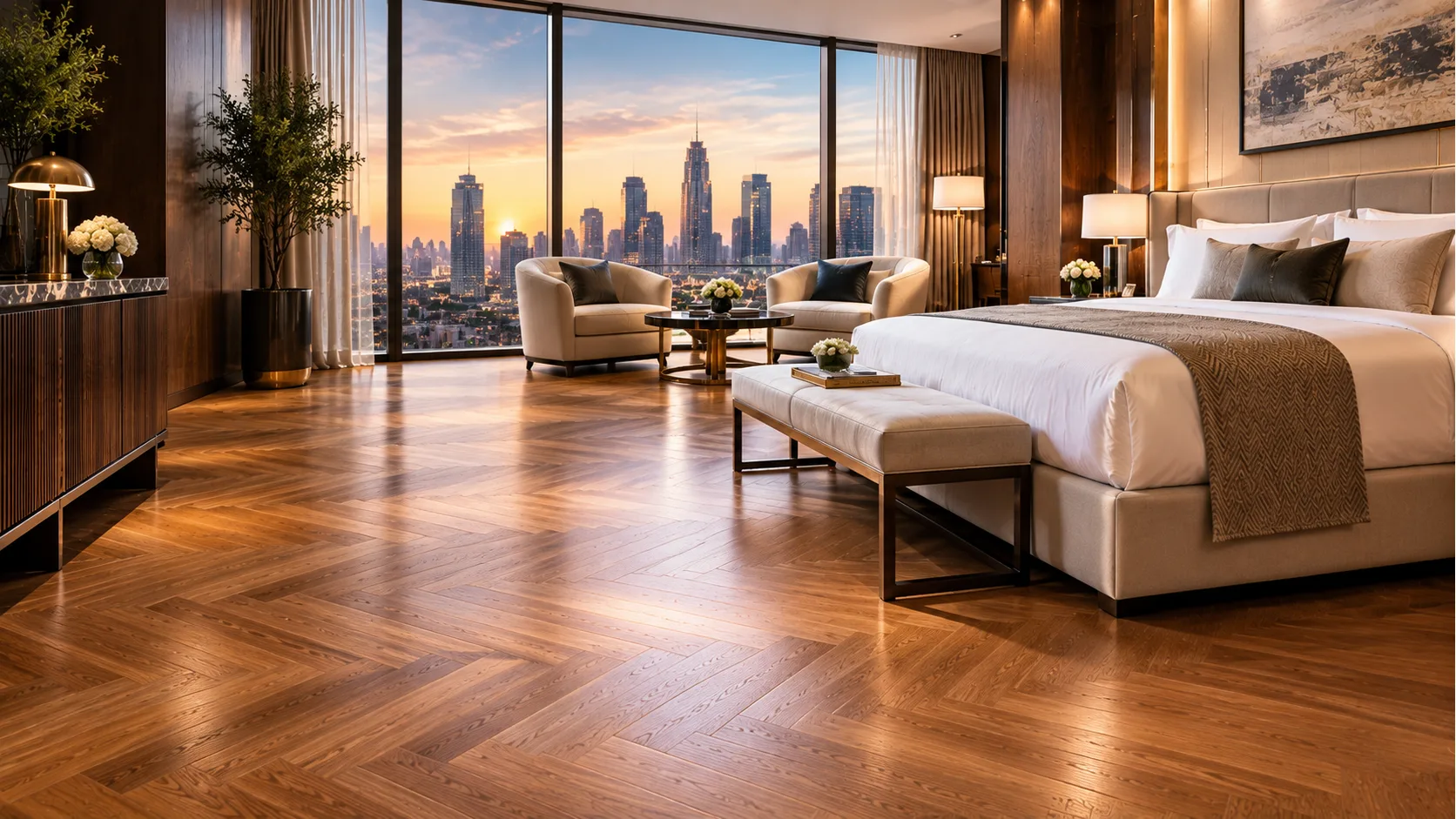
Step into the lobby of a leading luxury hotel and look down. Chances are the floor is doing as much work as the chandelier: a rhythmic pattern of wood blocks, laid with precision, polished by decades of footsteps. That is parquet flooring, and in an age of vinyl planks, large-format tiles and printed laminates, it remains a favourite of hotel designers for good reason.
Hotels cannot afford flooring that merely looks good on day one. Their floors face constant traffic, rolling luggage, heavy cleaning and the expectations of guests who judge a property within seconds. A material that passes that test, year after year, has lessons for every homeowner planning a wooden floor.
This guide explains why luxury hotels keep specifying parquet, how herringbone flooring and other patterns work, what to consider for Indian climate and budgets, and how to avoid the mistakes that spoil an otherwise beautiful floor. Whether you are a first-time buyer or renovating a villa, you will leave with a clear checklist.
Why do luxury hotels still choose parquet flooring? Because it combines three things few materials can: a recognisable sense of craftsmanship, durability that lasts decades with periodic refinishing, and a pattern-driven look (herringbone, chevron, basket weave) that makes a floor feel designed rather than simply installed. Homeowners can borrow the same logic: choose real wood, choose the right construction for the climate, and invest in subfloor preparation and installation quality.
What Is Parquet Flooring?
Parquet flooring is a type of wood floor made from smaller wood pieces (blocks, slats or fingers) arranged in a repeating geometric pattern. Instead of long planks running in one direction, the floor becomes a surface with rhythm: zigzags, diamonds, squares or interlocking rectangles.
The tradition is centuries old and is closely associated with European palaces and grand residences. That heritage is exactly why it remains a signature of high-end hospitality interiors today.
Common parquet formats
- Solid parquet blocks: Whole-wood pieces, typically sanded and refinished multiple times over their life.
- Engineered parquet: A real hardwood top layer bonded to a stable core, built to resist movement.
- Mosaic parquet panels: Small strips factory-assembled into panels for faster installation.
- Reclaimed or antique parquet: Salvaged blocks reused for character.
Why Luxury Hotels Keep Choosing Parquet
Hospitality design is brutally practical. A hotel lobby sees luggage wheels, heels, cleaning machines and thousands of footfalls. If a material survives that while still looking elegant, there is a reason. Here is what drives the decision.
1. It signals craftsmanship the moment guests walk in
A patterned wood floor is read instantly as handmade and considered. Guests may never name the material, but they register the effect: warmth, scale and quality. A lobby with a well-laid pattern feels established, which is difficult to achieve with printed or repeating surface materials.
2. It can be refinished instead of replaced
Solid and thick-wear-layer engineered parquet can be sanded and recoated. Hotels treat floors as long-term assets, so a surface that can be renewed between renovation cycles is financially smarter than one that must be ripped out.
3. The pattern hides daily wear
Small blocks in alternating directions break up light. Minor scuffs and fine scratches are far less noticeable than on a plain, uniform plank. For high-traffic corridors and suites, that visual camouflage matters.
4. It defines zones without walls
Designers use borders, inlays and changes in pattern to guide movement: a herringbone field leading into a bordered reception, or a chevron run along a corridor. It is architecture at floor level.
5. It improves acoustics and comfort compared with hard stone
Wood feels warmer underfoot and is less echo-prone than polished stone or tile. In guest rooms and suites, that contributes to a quieter, more residential feel.
6. It photographs well
In the era of social sharing, interiors are marketed visually. A distinctive floor gives a property a recognisable image, and pattern-led wood reads beautifully in photographs.
Key takeaway: Luxury hotels choose parquet because it works as both a design statement and a long-life surface, not because it is trendy.
What Hotels Know That Homeowners Often Miss
The hotel approach is less about the wood species and more about the process around it. These are the principles worth borrowing.
- They specify the floor for the use case. Lobbies get harder, denser woods or tougher finishes. Bedrooms can use softer, warmer tones.
- They prepare the subfloor obsessively. A flat, dry, sound base is non-negotiable before a single block is placed.
- They plan the layout on paper first. Pattern direction, borders and room transitions are decided before material arrives.
- They budget for finishing as a core step. Sanding grades and coating choices decide how a floor looks and ages.
- They schedule maintenance. Hotels recoat and screen floors on a cycle, not after damage appears.
- They buy from accountable suppliers. Consistency across batches, grading and installation support are treated as risk management.
If you are exploring Luxury Wooden Flooring Solutions for your own home, think like a hotel facilities manager: lifecycle value first, aesthetics second, impulse last.
Herringbone Flooring and Other Parquet Patterns
Herringbone flooring is the most requested parquet pattern worldwide. Rectangular blocks are laid at 90 degrees to each other, creating a broken zigzag. It feels classic yet fits modern interiors.
Popular parquet patterns explained
| Pattern | How it looks | Best suited for |
|---|---|---|
| Herringbone | Blocks meet at right angles, forming a staggered V | Living rooms, lobbies, foyers, classic and contemporary interiors |
| Chevron | Blocks cut at an angle so tips meet in a continuous point | Statement rooms, corridors, modern luxury apartments |
| Basket weave | Groups of blocks alternate direction like woven strands | Traditional or heritage-inspired spaces |
| Versailles-style panels | Larger square panels with diagonal inner pattern | Formal drawing rooms, period homes |
| Brick / stacked | Blocks offset in running rows | Budget-conscious or minimal looks |
Herringbone vs chevron, simply put: herringbone has a staggered, offset edge; chevron has a clean, continuous V line. Chevron needs more precise cutting and is typically costlier to install.
Parquet Flooring in India: Climate, Reality and Fit
This is the section most generic guides skip. Wood is a hygroscopic material: it absorbs and releases moisture. India’s range of conditions, from coastal humidity to monsoon-heavy cities to dry northern summers, means construction quality matters more here than in a temperate market.
What Indian conditions mean for wood
- Monsoon humidity can cause swelling in poorly acclimatised or poorly sealed floors.
- Dry heat and air conditioning cycles can cause contraction and gaps in low-quality wood.
- Concrete slabs on ground floors may carry residual moisture and need proper testing and barriers.
- Termite risk in some regions makes treated timber and a clean installation environment important.
- Dust and daily cleaning habits (wet mopping is common in Indian homes) require education, since water is wood’s biggest enemy.
Is Parquet Flooring for Indian Homes a practical choice?
Yes, when specified correctly. Parquet Flooring for Indian Homes works best when you:
- Choose engineered or well-seasoned solid wood suited to local humidity.
- Test slab moisture before installation and use appropriate underlays or moisture barriers.
- Let the material acclimatise on site before fixing.
- Use a quality finish (UV-cured oil or lacquer, depending on use).
- Keep indoor humidity within a stable range, using air conditioning or dehumidification where needed.
This is also why the demand for Premium Wooden Flooring in metro apartments, farmhouses and boutique hotels has grown: buyers increasingly want a warm, tactile surface that stone and vitrified tile cannot offer.
If you are comparing options in the broader market for Wooden Flooring India has to offer, ask suppliers how their products are engineered or seasoned for Indian climate zones, not only how they look in a showroom.
Parquet vs Plank vs Engineered vs Laminate (Comparison Table)
| Feature | Solid Parquet | Engineered Parquet | Wide Plank Wood | Laminate / Vinyl |
|---|---|---|---|---|
| Look | Authentic, pattern-rich | Authentic, pattern-rich | Clean, continuous | Printed imitation |
| Real wood surface | Yes | Yes (top layer) | Yes | No |
| Refinishing | Multiple times | Limited, depends on wear layer | Multiple times (solid) | Not possible |
| Humidity stability | Moderate; needs care | Higher | Moderate | High (water-resistant types) |
| Installation skill needed | High | Medium to high | Medium | Low |
| Resale and perceived value | Very high | High | High | Low to moderate |
| Typical lifespan with care | Decades | Decades (varies by wear layer) | Decades | Shorter |
| Best for | Heritage, luxury, long-term homes | Modern apartments, variable climates | Minimal, spacious interiors | Rentals, tight budgets |
Bottom line: For buyers who want the hotel-lobby effect with climate resilience, engineered parquet is often the practical middle ground, while solid parquet suits controlled, long-term residences.
Cost of Parquet Flooring in India
Pricing varies significantly by species, grade, block size, thickness, pattern complexity, finish and installer expertise. Treat any figure as indicative, and always request a written, itemised quotation.
What influences the final price
- Wood species and grade (the rarer or more uniform, the costlier)
- Solid vs engineered construction and wear-layer thickness
- Pattern complexity (chevron and borders add labour)
- Subfloor condition (levelling, moisture barriers, underlay)
- Sanding and finishing system
- Skirting, thresholds and transitions
- Site location and logistics
Approximate positioning (indicative only; confirm with current supplier quotes):
| Tier | Typical positioning | Notes |
|---|---|---|
| Entry premium | Engineered parquet, standard grades | Suitable for bedrooms and low-traffic areas |
| Mid premium | Quality engineered or select solid parquet | Good balance for living areas |
| High-end | Solid hardwood, custom patterns, borders | Statement spaces, villas, boutique hospitality |
Budget tip: Do not put all your money into the material. Allocate a meaningful share to subfloor prep, installation and finishing, since these decide longevity.
Installation: What Actually Decides the Outcome
Most parquet failures are installation failures, not material failures.
Step-by-step overview
- Site assessment: Check slab flatness, moisture level and temperature/humidity conditions.
- Subfloor preparation: Level, clean and, where needed, apply a moisture barrier.
- Acclimatisation: Store the wood in the installation space for the recommended period.
- Layout planning: Establish centre lines, pattern starting points and border dimensions.
- Fixing method: Glue-down, nail-down or a combination, depending on product and base.
- Expansion allowance: Leave perimeter gaps so the floor can move seasonally.
- Sanding and finishing: For unfinished floors, multi-stage sanding followed by oil or lacquer.
- Curing and handover: Avoid heavy furniture and moisture until finish is fully cured.
Hotel lesson: Large properties often commission mock-up areas first. Homeowners can do the same with a small test patch or sample board in their own lighting.
Maintenance and Refinishing
Daily care is simple, but the rules are strict.
Do
- Dust or vacuum with a soft-brush head regularly.
- Use a barely damp, wood-safe cleaner and wring thoroughly.
- Place mats at entrances and felt pads under furniture.
- Keep indoor humidity stable.
- Wipe spills immediately.
Avoid
- Wet mopping, steam mops or standing water
- Harsh acidic or abrasive cleaners
- Dragging heavy furniture
- Direct, prolonged sunlight without curtains or UV protection
Refinishing: Light screening and recoating can refresh a floor periodically, while full sanding is reserved for deeper wear. The wear-layer thickness (for engineered products) determines how many full sandings are possible.
Pros and Cons of Parquet Flooring
Pros
- Distinctive, high-end appearance
- Pattern hides minor wear
- Real wood warmth and comfort
- Refinishable (depending on construction)
- Adds perceived property value
- Wide range of species, tones and finishes
Cons
- Higher upfront cost than basic flooring
- Needs skilled installation
- Sensitive to water and humidity swings
- Requires routine care
- Pattern installation takes longer
Buying Guide: What to Check Before You Commit
- Define the room’s function. A bedroom and a high-traffic entrance need different specifications.
- Ask about construction. Solid, engineered, wear-layer thickness, core type and adhesive compatibility.
- Request moisture content details. Reputable suppliers can explain seasoning or stabilisation.
- See large samples in your own light. Small chips mislead.
- Verify the finish system. Ask about durability, maintenance and recoat compatibility.
- Check installer credentials. Ask for completed projects and, if possible, visit one.
- Get warranty terms in writing. Understand what is covered and what voids it.
- Plan for transitions and skirting. These details shape the final look.
Brands such as OAKA Floors focus on this broader view: helping buyers match wood type, pattern and construction to the space and climate, rather than selling a pattern in isolation. If you are shortlisting suppliers of Luxury Wooden Flooring Solutions, ask each one the same questions above and compare answers.
Common Mistakes Homeowners Make
- Skipping the moisture test on ground-floor or older slabs
- Choosing on photos alone without seeing physical samples
- Using parquet in wet zones like bathrooms or open balconies
- Hiring a general contractor instead of an experienced wood-floor installer
- Ignoring acclimatisation to save time
- Over-complicating the pattern in a small room, so it feels busy
- Forgetting cleaning-staff training (domestic help often default to wet mopping)
- Buying the cheapest veneer-thin product and expecting hotel-level durability
Expert Recommendations
- For apartments in humid cities: Prefer stable engineered parquet, paired with climate control during monsoon.
- For villas and long-term homes: Consider solid parquet if you can maintain consistent indoor conditions.
- For first-time buyers: Start with herringbone in a living room or foyer, where impact is highest, then extend later.
- For resale value: Neutral tones in oak-like shades have broad appeal; extreme colours date faster.
- For luxury effect on a smaller budget: Use a patterned parquet in a focal area and simpler flooring in secondary rooms.
Whether you are exploring Parquet Flooring in India for the first time or upgrading an existing home with Premium Wooden Flooring, a staged approach with sampling, climate planning and professional installation reduces risk.
Real-World Context: Hotels vs Homes
| Factor | Luxury Hotel Approach | Smart Homeowner Adaptation |
|---|---|---|
| Traffic | Very high; commercial-grade finishes | Match finish to household use; add rugs in hotspots |
| Maintenance | Scheduled professional recoating | Annual inspection, periodic screen-and-coat |
| Design | Pattern used for zoning and brand identity | Use pattern in key rooms, keep others calm |
| Procurement | Mock-ups, batch consistency checks | Ask for large samples, same-batch material |
| Risk management | Warranty, contracts, specialist installers | Written quotes, references, moisture testing |
| Lifecycle | Planned renovation cycles | Choose refinishable construction for long-term value |
Conclusion
Luxury hotels keep choosing parquet because it solves several problems at once: it impresses, it endures, and it can be renewed. The material matters, but the real lesson is the discipline behind it: right specification, right subfloor, right installer, right care.
For Indian homeowners, that translates into choosing stable construction, planning for climate, and treating installation as seriously as selection. Done properly, a patterned wood floor can give an apartment or villa the same quiet authority a great hotel lobby has.
If you are considering a parquet or herringbone floor and want to see how different wood types and patterns look in real spaces, you can explore the collections at OAKA Floors or speak with their team for guidance suited to your home.
FAQ Section
Why do luxury hotels use parquet flooring?
Hotels use it because it looks distinctive, handles heavy traffic, hides minor wear through its pattern, defines zones, and can be refinished over time instead of replaced.
Is parquet flooring suitable for Indian homes?
Yes. Parquet flooring for Indian homes performs well when the right construction (often engineered), proper moisture testing, acclimatisation and a quality finish are used, and when humidity is kept stable.
Is herringbone flooring better than plank flooring?
Neither is universally better. Herringbone flooring offers visual richness and hides wear, while plank flooring gives a cleaner, continuous look and can be simpler to install. The right choice depends on style, budget and the room.
Does parquet flooring work in humid climates?
It can, if the product is stabilised for humidity, the subfloor is dry, and indoor conditions are managed. Engineered parquet is generally more dimensionally stable than solid wood.
How long does parquet flooring last?
With proper installation and maintenance, wood parquet can last for decades. Refinishing extends life, subject to wear-layer thickness in engineered products.
How much does parquet flooring cost in India?
Cost depends on wood species, grade, construction, pattern and installation complexity. Request itemised quotations covering material, subfloor preparation, installation and finishing before comparing offers.
Can parquet flooring be used with underfloor heating?
Only certain constructions are suitable, and temperature limits must be followed. Always confirm compatibility with the manufacturer. This is rarely a concern in most Indian regions.
How do I clean parquet flooring?
Vacuum or dust regularly and use a slightly damp, wood-safe cleaner. Avoid wet mops and steam cleaners.
Where can I find premium wooden flooring in India?
Look for suppliers that explain wood sourcing, construction, finishing and installation support clearly. OAKA Floors specialises in wooden flooring and can guide you on suitable options for your space.