
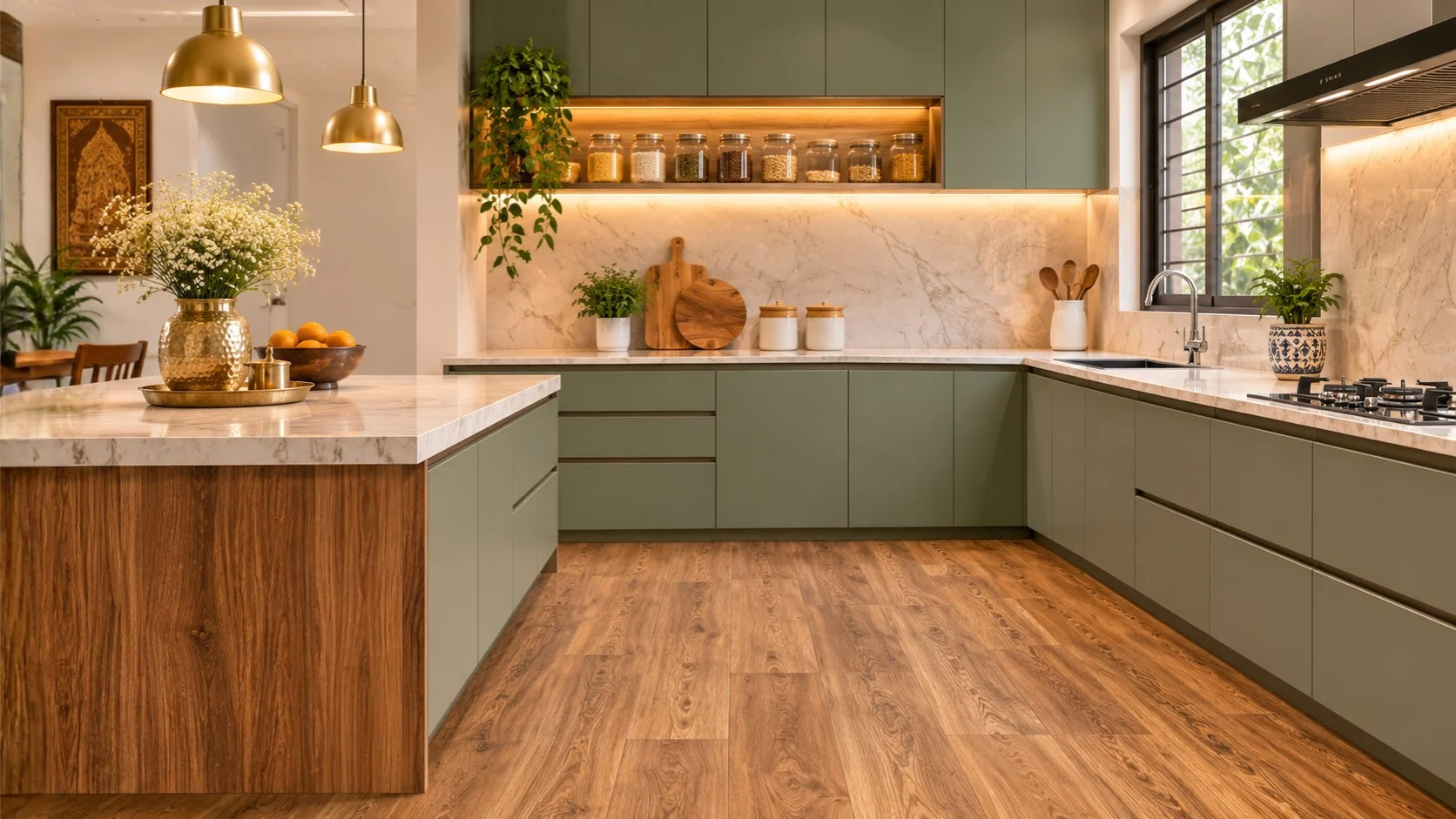
Most Indian homeowners love the warmth of a wooden floor but are told it cannot survive a kitchen. So is wood-look vinyl flooring a safe alternative, or just a compromise? For most households, it is a smart choice, with a few conditions.
Real timber does struggle with daily wet mopping, tadka splatter and monsoon humidity. But the look of wood no longer has to come with those risks. Modern luxury vinyl flooring reproduces oak, walnut and teak grain closely, and its core is fully waterproof. Vinyl plank flooring in rigid click-lock formats can often be installed over existing tiles in a day or two, with no demolition. The right waterproof wood flooring can give you the wooden look without the swelling.
Not every wood-look product suits a working kitchen, though. A printed board on a water-sensitive core will fail within a season. This guide explains which options work, how they compare, what installation really requires and which mistakes to avoid. If you are weighing vinyl flooring against real wooden flooring, you will find a clear answer for each part of your home.
Yes, wood-look vinyl flooring is suitable for Indian kitchens, provided it has a waterproof rigid core (SPC or WPC).
Solid wood and standard engineered wood often swell, cup or discolour near sinks, gas stoves and mopped zones. Luxury vinyl flooring, especially vinyl plank flooring, copies the grain of oak or walnut while resisting water, oil splashes and humidity. For Indian cooking conditions, choose a 4-6 mm plank with a 0.3-0.5 mm wear layer and a properly prepared subfloor.
Why Indian Kitchens Are Tough on Floors
A kitchen in India is not the same as a kitchen in the West. Before choosing any floor, consider what yours actually goes through:
- Daily wet mopping, often with phenyl or floor cleaners
- Tadka and frying, which cause oil vapour and splatter
- Monsoon humidity of 80-90% in Mumbai, Kolkata, Chennai and Kochi
- Hard-water spills from RO machines, pressure cookers and utility sinks
- Heavy loads such as gas cylinders, mixer grinders and refrigerators
- Concrete subfloors that can hold moisture for months after construction
Real hardwood reacts to almost all of these. So the useful question is not “Can I use wood-look flooring?” but “Which wood-look material will survive?”
Which Wood-Look Flooring Works in an Indian Kitchen?
1. Luxury Vinyl Flooring (Best Overall)
Luxury vinyl flooring is a multi-layer product with a printed décor film under a clear wear layer. Its core resists water completely. It comes in two common formats:
- LVT (Luxury Vinyl Tile/Plank): flexible, thinner, glue-down or click
- SPC (Stone Plastic Composite): a rigid, dense core that stays dimensionally stable in Indian summers
The look is convincing, with embossed-in-register grain you can feel underfoot.
2. Vinyl Plank Flooring (Best for Click-Lock Installs)
Vinyl plank flooring comes in long, wide boards, typically 180 mm × 1220 mm or larger. Rigid click-lock planks float over a levelled surface, so they suit kitchen renovations where you cannot spend weeks tearing up tiles.
3. Waterproof Wood Flooring (Hybrid and Specialty Options)
“Waterproof wood flooring” is used loosely in the market, so read the specification carefully. It usually means one of three things:
- A vinyl or SPC plank with a wood print (truly waterproof)
- A WPC (wood-plastic composite) board
- An engineered wood plank with a water-resistant coating (only water-resistant, not waterproof)
Only the first two belong in a working kitchen.
4. Solid and Engineered Wooden Flooring (Use with Caution)
Wooden flooring in teak, oak or ash is beautiful and adds resale value. However, it is risky within 1 metre of sinks and dishwashers, and in kitchens that are mopped wet. Many homeowners use premium wooden flooring in the living and dining areas and a wood-look vinyl in the kitchen. Together these luxury wooden flooring solutions keep the two zones visually connected while each material stays in the environment it suits.
Comparison Table: Wood-Look Flooring Options for Indian Kitchens
| Feature | Luxury Vinyl (SPC/LVT) | WPC Plank | Engineered Wood | Solid Wood | Wood-Look Ceramic Tile |
|---|---|---|---|---|---|
| Waterproof | Yes (100%) | Yes | No (water-resistant at best) | No | Yes |
| Oil/stain resistance | Excellent | Excellent | Moderate | Poor | Excellent |
| Feel underfoot | Soft to semi-rigid | Soft, warm | Warm, natural | Warm, natural | Cold, hard |
| Humidity tolerance | High | High | Moderate | Low | High |
| Repairable | Plank replacement | Plank replacement | Limited | Sand & refinish | Tile replacement |
| Kitchen suitability | ★★★★★ | ★★★★☆ | ★★☆☆☆ | ★☆☆☆☆ | ★★★★☆ |
Benefits of Wood-Look Vinyl Flooring in Kitchens
- Truly waterproof: the core will not swell with spills, leaks or monsoon damp
- Realistic grain: modern HD printing and embossing look convincing even up close
- Comfort: softer and warmer than tile, which helps if you stand and cook for long hours
- Quiet: an attached underlay reduces the clatter of dropped utensils
- Quick installation: often completed in 1-2 days over existing tiles, with no demolition mess
- Low maintenance: a damp mop is enough for daily care
- Design continuity: you can match the kitchen to adjoining wooden floors or an open-plan layout
Pros and Cons
Here is how wood-look vinyl compares with real wood or premium wooden flooring in a kitchen setting.
Pros
- Waterproof and humidity-stable
- Stain-resistant against turmeric, oil and tea
- A practical, cost-effective alternative to real wood
- Wide range of oak, walnut, teak and ash looks
Cons
- Can dent under sharp, heavy point loads (use furniture pads)
- Low-quality vinyl may fade in strong direct sunlight
- Not as repairable as real wood
- Poor subfloor preparation will show through the surface
What About Heat, Gas Stoves and Spills?
This is the question many Indian homeowners ask, and few guides answer it directly.
- Hot utensils: never place a hot pressure cooker or tawa directly on any vinyl floor. Use trivets.
- Gas burners: the floor itself is fine, but keep it clear of direct heat sources, and check the manufacturer’s clearance before installing near built-in ovens.
- Underfloor heating: use only products rated for it. This is rarely an issue in most of India.
- Sunlight: kitchens with large west-facing windows should use planks with UV-stable wear layers.
- Cleaning chemicals: avoid acid-based cleaners and harsh solvents, since they can dull the wear layer.
Installation: What Actually Matters
Good products fail on poor installation. A professional installer should follow this sequence:
- Check subfloor moisture. Concrete should be dry, and fresh screeds need adequate curing time.
- Level the surface. Gaps of more than 3 mm over 2 metres need self-levelling compound.
- Clean thoroughly. Dust and oil residue prevent bonding.
- Acclimatise the planks for 24-48 hours in the room.
- Leave an expansion gap of 5-8 mm along walls, hidden by skirting.
- Click-lock or glue down according to the product specification.
- Seal edges near the sink and wet zones with a suitable flexible sealant.
- Avoid heavy loads such as refrigerators and cabinets for 24 hours.
Professional wooden flooring installation services save money in the long run. A badly levelled kitchen floor leads to gaps, lifted edges and warranty disputes. Ask any installer whether they are trained on your specific product and whether they offer a workmanship warranty.
Maintenance Tips for Indian Households
- Sweep or vacuum daily to remove grit, which acts like sandpaper
- Use a damp, not soaking, mop with a pH-neutral cleaner
- Wipe oil splatter immediately to avoid sticky buildup
- Place mats at the sink and stove
- Lift appliances, never drag them
- Avoid steam mops unless the manufacturer approves them
- Keep rubber-backed mats off the floor, since some can discolour vinyl
Common Mistakes Homeowners Make
- Buying “wood-look” without checking the core. A wood print on a water-sensitive board is not waterproof.
- Choosing the cheapest thin vinyl. Planks under 3 mm with a thin wear layer scuff quickly.
- Skipping subfloor preparation. This is the most common cause of failure.
- Ignoring the wear layer. For kitchens, 0.3-0.5 mm is the minimum worth considering.
- Using dark glossy finishes everywhere. They show every water spot and footprint.
- Not asking about warranty terms. Read what is excluded, especially moisture and heat.
- Installing under fixed cabinets. Install only up to the cabinet base. Do not float a floor beneath heavy built-ins.
Buying Guide: What to Check Before You Order
| Checkpoint | What to Look For |
|---|---|
| Core type | SPC or WPC for rigid stability |
| Thickness | 4-6 mm for kitchens |
| Wear layer | 0.3-0.5 mm |
| Water rating | 100% waterproof core, not just a surface coating |
| Surface texture | Embossed-in-register grain for realism |
| Finish | Matte or low-gloss to hide water spots |
| Underlay | IXPE or EVA attached underlay |
| Certifications | Low-VOC / formaldehyde-free test reports |
| Warranty | Residential kitchen use explicitly covered |
| Installation support | Trained installers, reliable wooden flooring installation services and after-sales care |
Expert Recommendations
- Open-plan homes: use the same wood-look vinyl plank across kitchen, dining and living areas to make the space feel larger.
- Small urban kitchens: choose lighter oak and ash tones, which reflect light.
- Joint families with heavy cooking: go for the thickest wear layer you can afford and a matte finish.
- Rental or resale properties: wood-look vinyl gives a premium feel without the maintenance risk.
- Coastal and humid cities: prioritise SPC for its stability. Buyers researching wooden flooring Dubai face similar humidity and AC-cycling conditions, so the same waterproof-first logic applies.
- Mixed approach: pair a waterproof kitchen floor with luxury wooden flooring solutions in bedrooms and living rooms, so each room uses the right material.
Where OAKA Floors Fits In
OAKA Floors offers wood-look flooring for residential and commercial spaces, including luxury vinyl flooring, vinyl plank flooring and premium wooden flooring collections. You can explore options by look, thickness and application, and discuss kitchen suitability before you buy. Whether you are planning a single kitchen or a full home, the team can help you match luxury wooden flooring solutions to each room’s moisture and traffic conditions. Homeowners comparing wooden flooring Dubai options can use the same checklist from this guide.
Conclusion
Wood-look vinyl flooring suits an Indian kitchen well, as long as the core is waterproof, the wear layer is sturdy and the installation is done properly. For most households, luxury vinyl flooring and rigid vinyl plank flooring deliver the warmth of wood without the worries of swelling, staining or monsoon damage. Reserve premium wooden flooring for the rooms where it can thrive, and let waterproof wood flooring handle the hardest-working room in the house. If you are comparing wooden flooring Dubai options for a humid-climate home, the same rules apply.
If you are planning a kitchen upgrade, you can browse OAKA Floors’ collections and speak with the team about samples, thickness options, luxury wooden flooring solutions and wooden flooring installation services. A short consultation before you buy often prevents the most expensive flooring mistakes.
FAQ Section
Is wood-look vinyl flooring suitable for Indian kitchens?
Yes, if it has a waterproof SPC or WPC core. Rigid vinyl planks handle spills, oil and humidity far better than solid or engineered wood, as long as the subfloor is prepared properly.
What is the best flooring for a kitchen that looks like wood?
A rigid wood-look plank generally offers the best balance of realism, water resistance and value for Indian kitchens.
Is vinyl flooring good for kitchens in India?
Yes. Vinyl flooring is waterproof, stain-resistant and comfortable underfoot. Choose a sufficient wear layer and professional installation for best results.
Can real wooden flooring be used in a kitchen?
It can, but moisture and daily wet mopping create risk. Most homeowners keep wooden flooring in dry areas and use waterproof wood flooring alternatives in the kitchen.
Do rigid vinyl planks fade or warp in Indian summers?
Quality SPC planks resist warping. Prolonged direct sunlight can fade low-grade products, so choose UV-stable options for sun-exposed kitchens.
Can I install vinyl flooring over existing tiles?
Often yes, if the tiles are firmly bonded and level. Deep grout lines may need filling first, and a professional should assess the surface.
Do I need professional installation?
Strongly recommended. Professional wooden flooring installation services handle subfloor checks, levelling and sealing, which determine how long the floor lasts.