
Our The Complete Guide to Hybrid Wood Flooring in India
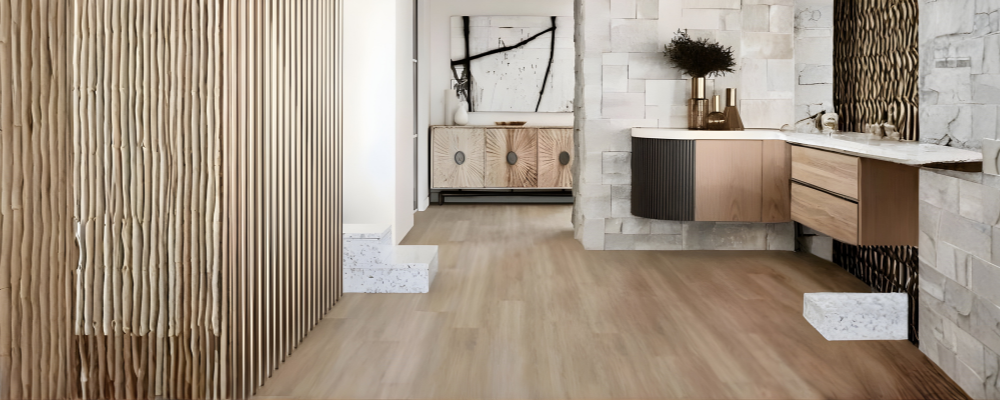
Hybrid wood flooring combines a rigid SPC core with LVT layers to deliver 100% waterproof, scratch-resistant floors that look and feel like real wood – without the maintenance headaches. India’s vinyl flooring market hit USD 1,266 million in 2025 and is growing at 7.3% annually, driven by homeowners upgrading from cold tiles and high-maintenance marble. If you want a floor that handles Indian monsoons, spills, pets, and heavy foot traffic while still looking gorgeous, hybrid flooring is your answer.
Introduction
India’s relationship with flooring is changing fast. For decades, marble, granite, and vitrified tiles dominated every new build – and for good reason. They’re durable, familiar, and available everywhere. But something has shifted. Homeowners in Mumbai, Bengaluru, Ahmedabad, and Dubai are asking a different question: why am I paying so much to maintain floors that still feel cold, chip at grout lines, and look dated in five years?
Hybrid wood flooring answers that question directly. India’s vinyl flooring market reached USD 1,266 million in 2025 and is projected to double by 2035, reflecting a genuine revolution in how Indians choose to live on their floors. Architects, interior designers, and homeowners are discovering that you can have the warmth and elegance of wood, the strength of stone composite, and the waterproofing that Indian climates demand – all in a single product.
This guide covers everything: what hybrid flooring actually is, how it performs against traditional options, which patterns suit which spaces, and how to choose the right shade for your home’s design story. We’ve drawn on real competitor research, SERP data, and our own production knowledge to give you the most useful guide on hybrid floors in India today.
What Is Hybrid Wood Flooring?
Hybrid wood flooring is a multi-layer flooring product that fuses the rigidity of SPC (Stone Plastic Composite) with the visual warmth and underfoot comfort of LVT (Luxury Vinyl Tile). The result is a floor that is harder and more dimensionally stable than standard vinyl, warmer and quieter than pure SPC, and dramatically more water-resistant than laminate or hardwood.
At OAKA, our hybrid floors are engineered in seven distinct layers:
- 1. IXPE Attached Pad (1.0 mm) – the silent hero. This foam pad reduces impact noise by up to 19 dB, which matters enormously in multi-storey apartments and co-living spaces.
- 2. LVT Bottom Layer – provides additional flexibility and acts as a moisture buffer from below.
3. SPC Rigid Core – the backbone. A blend of limestone, PVC, and stabilisers creates a core that will not flex, bow, warp, or buckle regardless of temperature swings. - 4. LVT Middle Layer – adds dimensional stability and bridges the core to the decorative surface.
- 5. Decor Film Layer – high-definition digital printing that replicates oak, walnut, ash, and other timber grains with photographic accuracy.
- 6. Wear Layer (0.5 mm) – the protective shield. This transparent layer resists scratches, stains, and daily abrasion from foot traffic, furniture, and pet claws.
- 7. UV Coating – a final cured finish that locks in colour, resists fading from sunlight, and adds a natural lustre.
What hybrid flooring is NOT: It is not laminate (which uses a wood-fibre core that absorbs water), not standard LVT (which lacks a rigid core), and not engineered hardwood (which uses a real wood veneer that still requires care in humid climates).
Why Indian Homes Are Switching to Hybrid Floors
The shift isn’t aesthetic fashion – it’s practical logic applied to real Indian living conditions.
The monsoon problem. Indian homes face humidity swings that laminate floors simply cannot handle. Laminate swells, buckles at joints, and once water gets under the surface, the damage is irreversible. Hybrid floors with SPC cores are dimensionally stable across temperature and humidity changes. They don’t expand and contract the way wood products do.
The cold tile problem. Marble and vitrified tiles are visually beautiful, but they feel cold in winter, get slippery when wet, and produce a hard, echoing sound when walked upon. OAKA’s IXPE underpad keeps the floor warmer underfoot and reduces the hollow footstep sound that plagues high-rise apartments.
The maintenance problem. Marble needs annual polishing. Hardwood requires refinishing, humidity control, and careful cleaning. Hybrid floors need nothing more than a regular sweep and an occasional damp mop. The 0.5 mm wear layer means spills, muddy shoes, and pet claws don’t leave marks.
The cost problem. Real hardwood floors in India can cost ₹350–₹600+ per square foot, including installation. Premium hybrid flooring delivers a near-identical aesthetic at a fraction of the cost, with a longer realistic lifespan in Indian conditions because it won’t deteriorate in humidity.
Market validation: India’s vinyl flooring market is growing at 7.3% CAGR through 2035, and the surge is concentrated in residential high-rise developments, premium apartments, and renovation projects where tile removal isn’t practical. Hybrid floors can be installed directly over existing tile or concrete surfaces – a major advantage in renovation work.
Layer by Layer: How OAKA Hybrid Floors Are Built
Understanding construction helps you buy wisely, because not all hybrid floors are equal.
The SPC Rigid Core: Where Stability Lives
The SPC core is the defining difference between OAKA hybrid flooring and softer vinyl planks. Limestone powder and PVC are combined under heat and pressure into a composite that is denser and harder than wood, yet lighter and more resilient than stone tile. This core is dimensionally stable – it won’t flex under furniture legs, won’t bow across long plank runs, and won’t telegraph subfloor imperfections.
For Indian homes specifically, this matters because concrete subfloors are rarely perfectly level. Standard LVT will show bumps and undulations through the finished surface; the rigid SPC core bridges minor imperfections.
The Wear Layer: Your Floor’s Long-Term Defence
OAKA specifies a 0.5 mm wear layer, which places our product in the upper tier of residential hybrid flooring. To put this in perspective, entry-level vinyl products use 0.2–0.3 mm wear layers. At 0.5 mm, the floor handles families with children, pets, high heels, and rolling furniture with ease. The layer also carries the UV-cured coating, which means colour doesn’t fade near sun-facing windows over years of use.
The IXPE Underpad: The Comfort You Feel
IXPE (Irradiation Cross-linked Polyethylene) is an engineered foam that provides 10x compression resistance compared to standard PE foam. It cushions footfall, reduces impact noise, and adds a slight thermal insulation effect. For apartment living, this translates to noticeably quieter floors and less of that “cold and hard” sensation when walking barefoot.
Straight Plank vs Herringbone: Choosing Your Pattern
Pattern choice is one of the most significant design decisions in flooring – and one of the most underexplained in competitor content. Here’s how to think about it properly.
Straight Plank (180 × 1500 mm)
Straight planks laid in a parallel or staggered-brick pattern are the most versatile choice. Long planks – like OAKA’s 1500 mm format – elongate rooms visually and make smaller apartments feel more spacious. The long lines draw the eye across the floor rather than breaking the visual field.
Best for: Rectangular rooms, open-plan layouts, spaces with strong architectural lines, contemporary and Scandinavian-inspired interiors. The format works particularly well in bedrooms and living areas where you want the floor to feel generous and uncluttered.
Herringbone (110 × 610 mm)
Herringbone is arguably the most requested pattern in premium interior design right now. The interlocking V-shaped arrangement of rectangular planks creates a visual rhythm that communicates craftsmanship and sophistication without a single word. It makes rooms feel deliberately designed – not just furnished.
The geometric complexity also has a practical visual effect: herringbone makes narrow rooms feel wider and longer rooms feel more proportioned. Interior designers frequently specify it in corridors, entry halls, and open-plan living areas for this reason.
The common mistake with herringbone is choosing planks that are too wide. At 110 mm, OAKA’s herringbone flooring hit the pattern’s architectural sweet spot – visible weave, defined angles, and enough repeat to read correctly across a full room.
Best for: Living rooms, hallways, dining areas, reception spaces, boutique retail, hospitality interiors. Pairs especially well with neutral walls, natural stone feature elements, and warm metallic hardware.
OAKA Herringbone Collection shades to consider:
- Melbourne – warm walnut tones with timeless charm
- Tromsø – Scandinavian cool for modern minimalism
- Ibiza – light, airy coastal feel
- Nevada – soft light grain for relaxed, open spaces
Pattern Decision Guide
| If your space is… | Choose… |
|---|---|
| Open-plan, modern, minimal | Straight – wide plank, light or mid shade |
| Narrow hallway or corridor | Herringbone – diagonal angles widen the visual field |
| Traditional or classic interior | Herringbone in warm walnut or oak tones |
| Studio or small apartment | Straight – long planks elongate the space |
| Hospitality or luxury retail | Herringbone – communicates premium design instantly |
| Bedroom (comfort priority) | Either – straight is simpler, herringbone more distinctive |
Hybrid Flooring vs Other Popular Options in India
Indian homeowners typically evaluate five flooring types before making a final choice. Here’s an honest comparison.
Hybrid Flooring vs Marble
Marble wins on raw prestige and natural variation. But it requires annual polishing, seals regularly to prevent staining, chips at edges, feels cold in winter, gets slippery when wet, and costs significantly more installed. Hybrid flooring delivers a warm, slip-resistant surface at lower cost with zero maintenance obligations.
Verdict: Marble remains aspirational for formal living and dining rooms. Hybrid flooring is superior for everyday liveable spaces – bedrooms, family rooms, home offices.
Hybrid Flooring vs Vitrified Tile
Vitrified tiles dominate India’s mid-market because they’re durable and water-resistant. However, grout lines require regular cleaning, the hard surface magnifies footfall noise in apartments, and standard tiles feel cold underfoot. Hybrid flooring is warmer, quieter, and can be installed directly over existing tiles during renovation without demolition.
Verdict: Hybrid flooring is better for living zones; vitrified tiles remain practical for utility kitchens and wet rooms with drains.
Hybrid Flooring vs Laminate
This is the most commonly confused comparison. Laminate uses a wood-fibre core that absorbs moisture – it will swell, warp, and discolour when exposed to water. In India’s humid climate, laminate is a risky choice for ground floors, kitchens, or any room with AC condensation risk. Hybrid SPC flooring is fully waterproof by design.
Verdict: For India, hybrid flooring is categorically safer than laminate in any area with moisture exposure.
Hybrid Flooring vs Engineered Hardwood
Engineered hardwood uses a real wood veneer over a plywood core – it looks and feels like solid wood because the surface layer genuinely is wood. It can be refinished once or twice across its lifespan. However, it’s vulnerable to prolonged moisture, significantly more expensive, and requires careful humidity management. In coastal Indian cities or homes without consistent AC, engineered wood can still face warping issues.
Verdict: For a home where cost, maintenance-free living, and waterproofing are priorities, hybrid flooring wins. Engineered hardwood is the choice when authenticity of material and refinishing potential justify the premium.
Room-by-Room Guide: Where to Use Hybrid Flooring
Living Room
The living room demands visual impact. Herringbone in a warm walnut shade (Melbourne, Warsaw) creates a focal point that elevates the entire space. Long straight planks in Stockholm or Nevada make open-plan rooms feel expansive. OAKA’s IXPE pad reduces the resonance common in concrete-slab Indian apartments.
Bedroom
Comfort underfoot is the priority. Both straight and herringbone patterns work here. Light neutrals – Nevada, Stockholm – create a restful, airy atmosphere. The IXPE pad adds measurable warmth in winter. Avoid dark shades if the room lacks natural light.
Home Office
A hybrid floor in a study or home office communicates professionalism while remaining practical under rolling chair castors. Choose mid-tones (Detroit, Melbourne) that photograph well for video calls without visual distraction. The hard surface is cleaner than carpet and easier to maintain.
Hallway & Entry
This is where herringbone belongs most naturally. The pattern slows the eye and makes a strong first impression. The wear layer’s scratch resistance is critical here – this is the highest-traffic zone in any home, and cheap floors show it within months.
Staircase
OAKA offers a staircase solution where the material is shaped to follow stair contours continuously, eliminating visible joints at the nosing. This gives a seamless, custom finish that no tile solution can match at a comparable price.
Commercial: Boutique Retail & Hospitality
For café interiors, hotel lobbies, boutique showrooms, and co-working spaces, herringbone hybrid flooring signals deliberate design. It is durable enough for commercial foot traffic – the 0.5 mm wear layer and SPC core hold up under daily punishment – while remaining easy to maintain between cleaning cycles.
Installation, Maintenance & Care
Installation
OAKA hybrid floors use a precision click-lock system (Unilin/T-lock compatible). Planks connect without nails or adhesive, float over the subfloor, and can be installed over existing tile, concrete, or hardwood substrates that are clean and reasonably level.
Steps in brief:
- Ensure subfloor is clean, dry, and level to within 3 mm per 1800 mm span
- Acclimate planks in the installation room for 24–48 hours
- Start from the longest, straightest wall; maintain 8–10 mm expansion gap at all perimeters
- Click and lock row by row; use a tapping block to avoid damaging the locking profile
- Finish perimeters with OAKA matching skirting boards to conceal the expansion gap
For herringbone, begin from the room’s centre point and work outward. This ensures the pattern is symmetrical relative to the room’s geometry.
Ongoing Maintenance
- Daily: Sweep or vacuum with a soft attachment; no beater bars
- Weekly: Damp mop with a pH-neutral cleaner diluted in water
- What to avoid: Steam mops (excess heat can stress locking joints), harsh chemicals, soaking mops
- Scratch prevention: Use felt pads under furniture legs; door mats at all entry points
Spills & Stains
OAKA’s wear layer and UV coating mean most spills – including red wine, cooking oil, and ink – wipe clean immediately with a damp cloth. For dried or stubborn marks, a small amount of isopropyl alcohol on a soft cloth works without damaging the surface.
How to Choose the Right Shade for Indian Interiors
Shade selection is where many buyers spend the most time and receive the least guidance. Here’s a framework.
For large, well-lit spaces: Any shade works. Darker tones – Warsaw, Detroit – add richness and drama. Mid-tones – Melbourne, Bombay – are the most versatile. Herringbone in a warm walnut creates a sense of considered design that large rooms can carry easily.
For Indian interior styles:
- Contemporary minimalist: Stockholm, Nevada – cool, pale, Scandinavian-inspired
- Warm eclectic: Warsaw, Melbourne – earthy depth with character
- Coastal/Kerala/Tropical: Ibiza, Nevada – airy, light, warm-toned neutrals
- Traditional Rajasthani or heritage: Bombay, Detroit – rich, formal tones that complement decorative walls and ornate furniture
For small or low-light rooms: Choose light neutrals – Nevada, Stockholm, Ibiza. These shades bounce light and prevent the room from feeling smaller. Avoid dark or very warm tones, which absorb light and make compact rooms feel enclosed.
The visual sample test: Always request a physical sample before deciding. View it in your room at different times of day – Indian sunlight in the afternoon versus evening artificial light will show very different warmth in the same plank.
FAQ
Conclusion
Hybrid wood flooring is the most practical premium flooring choice for Indian homes in 2026: it is waterproof, warm underfoot, low-maintenance, and available in patterns and shades that compete aesthetically with materials costing two to three times as much. The SPC rigid core solves the humidity problem that disqualifies laminate and challenges engineered hardwood in Indian conditions. The IXPE underpad solves the cold-tile problem that tiles and marble cannot address without expensive heating systems.
Whether you choose straight planks to expand a small apartment or herringbone to give your living room an architectural centrepiece, OAKA’s 7-layer construction delivers a floor built for the way Indian families actually live – barefoot in the morning, spills at dinner, monsoon mud at the door, and guests every weekend.
The India vinyl flooring market is projected to reach USD 2,562 million by 2035. This isn’t a trend. It’s a permanent shift in how quality homes are built.
Continue Learning
Flooring Fundamentals:
- What is SPC Flooring? A Complete Guide for Indian Homes
- Rigid Vinyl vs LVT vs Laminate: Which Is Right for You?
Design Guides:
- How to Choose the Right Flooring Pattern for Your Room Size
- Flooring Shade Guide for Indian Interior Styles
Installation & Care:
- How to Install OAKA Click-Lock Flooring in 8 Steps
- Caring for Your Hybrid Floor: Annual Maintenance Checklist
Product Deep-Dives:
OAKA Staircase Solutions: Seamless Finishes from Floor to Step
Herringbone Flooring: Why Designers Always Recommend It