
Why Pattern Matters as Much as Wood
Most people choosing wooden flooring focus on two things — the wood species and the finish. What often gets overlooked is the layout pattern, even though it’s doing quiet, constant work on how a space is perceived.
A plank running lengthwise down a corridor makes it feel longer. A herringbone pattern laid diagonally across a compact living room can make the same square footage feel noticeably more open. This isn’t decorating theory — it’s basic visual perception, and it’s the reason parquet flooring has stayed relevant for centuries, from 17th-century French châteaux to modern Indian apartments and villas.
At OAKA Floors, this is a conversation we have with nearly every client: the pattern isn’t a finishing touch, it’s a design decision that should be made early, alongside layout and lighting plans — not after the furniture is in.
What Is Parquet Flooring? (Definition & Origin)
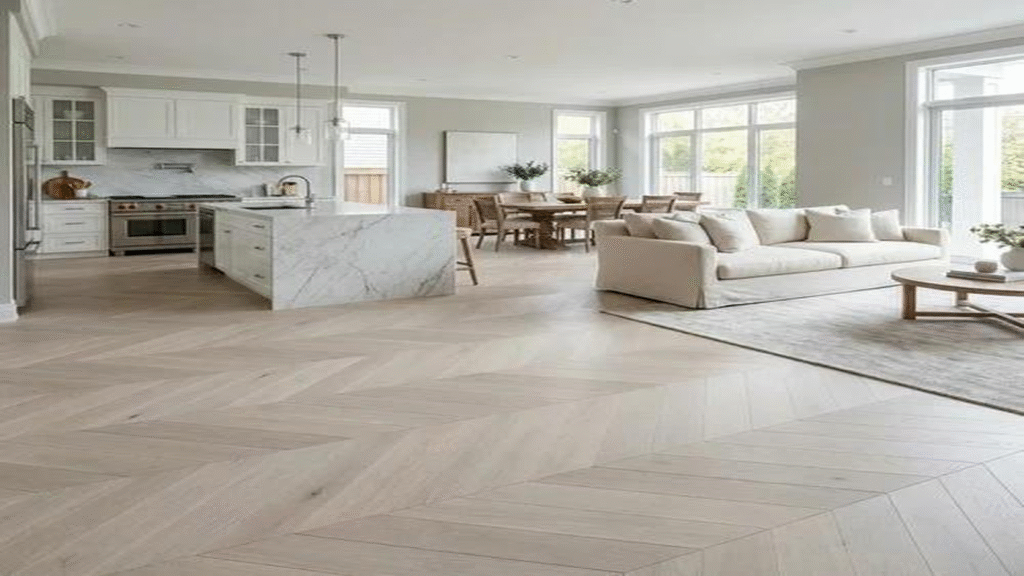
Parquet flooring is a type of wood flooring constructed from small, uniformly cut pieces of wood — called “fingers” or “blocks” — arranged into geometric patterns rather than laid as long, continuous planks.
Key characteristics:
- Made primarily from hardwoods like oak, walnut, or teak
- Assembled in repeating geometric patterns (herringbone, chevron, basket weave, etc.)
- Can be solid wood or engineered wood construction
- Originated in 16th-century France as a durable, decorative alternative to marble flooring
Unlike standard strip or plank flooring, parquet is inherently designed around pattern-driven visual structure — which is exactly why its impact on a room’s perceived light and space is so significant.
What Is Parquet Flooring?
Parquet flooring is a premium wooden flooring style created by arranging small wood pieces—most commonly oak wood flooring—into elegant geometric patterns such as herringbone, chevron, and basket weave. More than a decorative choice, these layouts influence how a room is perceived by guiding the eye, reflecting natural light, and creating a greater sense of depth and movement. This ability to visually enlarge spaces and enhance interior aesthetics is why parquet flooring continues to be one of the most preferred flooring solutions among architects and interior designers.
The direction of a parquet pattern can visually widen a narrow hallway, brighten darker rooms by improving light reflection, and introduce rhythm and sophistication into open-plan interiors—making it both a functional and design-driven flooring choice.
The Science: How Pattern Direction Affects Light & Space
1. Diagonal Patterns Create the Illusion of More Space
Diagonal layouts — like a 45-degree herringbone or chevron — break the eye’s natural tendency to measure a room along its walls. Instead of tracing a straight line from one end to the other, the eye follows the zigzag rhythm of the pattern, which visually expands the perceived width and depth of a room.
This is particularly useful in:
- Compact apartments (a common scenario in Indian metros like Mumbai, Bengaluru, and Delhi NCR)
- Narrow hallways and entryways
- Studio layouts with open-plan living
2. Pattern Direction Controls How Light Travels Across a Floor
Wood grain and pattern joints reflect light differently depending on their angle relative to the light source.
- Herringbone wooden flooring laid perpendicular to a window reflects light in short, broken intervals, creating subtle shimmer and reducing glare.
- Straight plank flooring running parallel to light reflects it in long, uninterrupted streaks — good for a calm, minimal look but less dynamic.
- Chevron patterns, with their continuous zig-zag lines, create a stronger directional pull and make light appear to “travel” across the room.
Practical takeaway: In low-light rooms (common in ground-floor apartments or homes with limited window area), a herringbone or chevron layout in a lighter oak tone will visibly brighten the space more than a straight-laid plank in the same wood.
3. Scale of the Pattern Affects Perceived Room Size
Smaller, tighter patterns (like a fine herringbone) tend to make a room feel busier but larger in scale, since more joints and lines register per square foot. Larger-format parquet blocks or wide-plank chevron create a calmer, more spacious feel but can make a small room feel visually cluttered if overdone.
Simple rule of thumb:
| Room Type | Recommended Pattern Scale |
|---|---|
| Small bedrooms, compact apartments | Fine herringbone, narrow chevron |
| Large living rooms, open-plan halls | Wide-plank herringbone/chevron, basket weave |
| Hallways & corridors | Diagonal herringbone (elongates the path) |
| Formal/traditional interiors | Classic basket weave, Versailles pattern |
Popular Parquet Patterns & Their Visual Effect
Herringbone
The most in-demand pattern globally and in India. Pieces are laid at 90-degree angles to each other in a “V” zig-zag. Herringbone wooden flooring adds movement and energy without feeling chaotic, making it ideal for both modern and classic interiors.
Chevron
Similar to herringbone but pieces are cut at an angle so the pattern forms a continuous, unbroken “V.” Chevron feels more streamlined and formal — a favourite in luxury wooden flooring solutions for living rooms and hotel lobbies.
Basket Weave
Square blocks arranged to resemble a woven basket. This pattern reads as more traditional and works especially well in larger, symmetrical rooms.
Versailles Pattern
An intricate, high-end parquet design historically used in French palaces. Reserved for statement spaces — foyers, formal dining rooms — where flooring itself becomes a design centerpiece.
Straight & Brick Bond Layouts
Simpler, understated patterns for those who want the warmth of wood flooring without a strong geometric statement.
Why Oak Is the Preferred Wood for Parquet Flooring
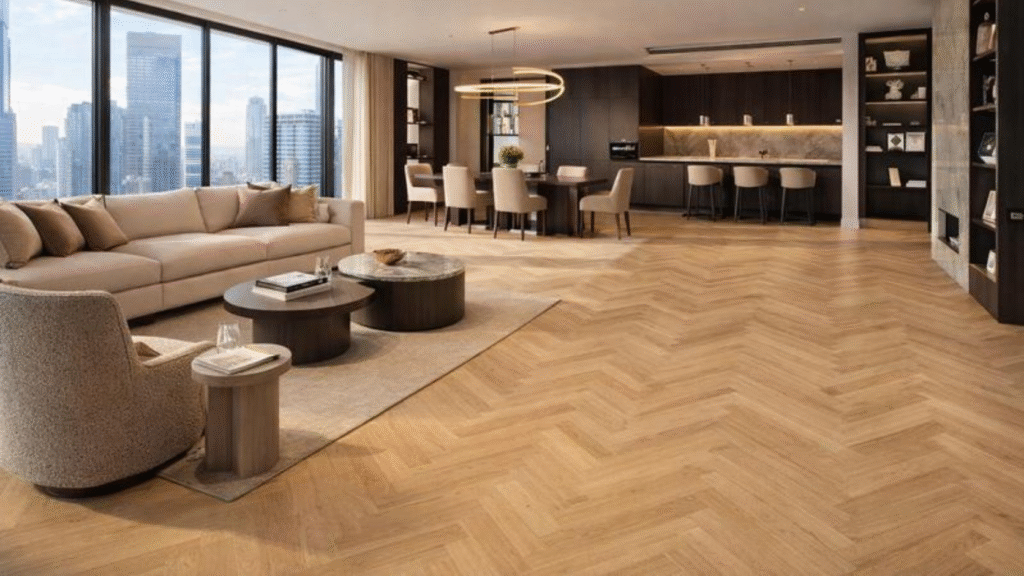
Oak flooring dominates the parquet category worldwide, and for good structural and aesthetic reasons:
- Density & durability: Oak wood flooring has a Janka hardness that comfortably withstands high foot traffic, making it suitable for both homes and commercial interiors.
- Grain character: Oak’s visible, consistent grain pattern complements geometric layouts like herringbone without competing with them visually.
- Stability: Engineered oak wood flooring resists warping better than many softer woods, which matters in India’s varied humidity conditions — from coastal moisture to dry interior climates.
- Tone versatility: Oak takes stains and finishes exceptionally well, from pale Scandinavian whites to deep, warm walnuts — giving designers full control over how light interacts with the pattern.
This combination of strength and adaptability is why oak flooring remains the backbone of most premium wooden flooring collections, including those at OAKA Floors.
Parquet Flooring vs. Other Wooden Flooring Types
| Feature | Parquet Flooring | Standard Plank Flooring | Laminate Flooring |
|---|---|---|---|
| Visual pattern | Geometric (herringbone, chevron, etc.) | Straight, linear | Straight, printed wood texture |
| Material | Solid or engineered hardwood | Solid or engineered hardwood | Composite/laminate core |
| Light & space effect | Strong — actively shapes perception | Moderate | Minimal |
| Durability | High (with real wood) | High | Moderate |
| Cost | Premium | Mid to premium | Budget-friendly |
| Best for | Statement interiors, luxury spaces | Everyday homes, minimal aesthetics | Cost-conscious renovations |
Benefits of Parquet Flooring
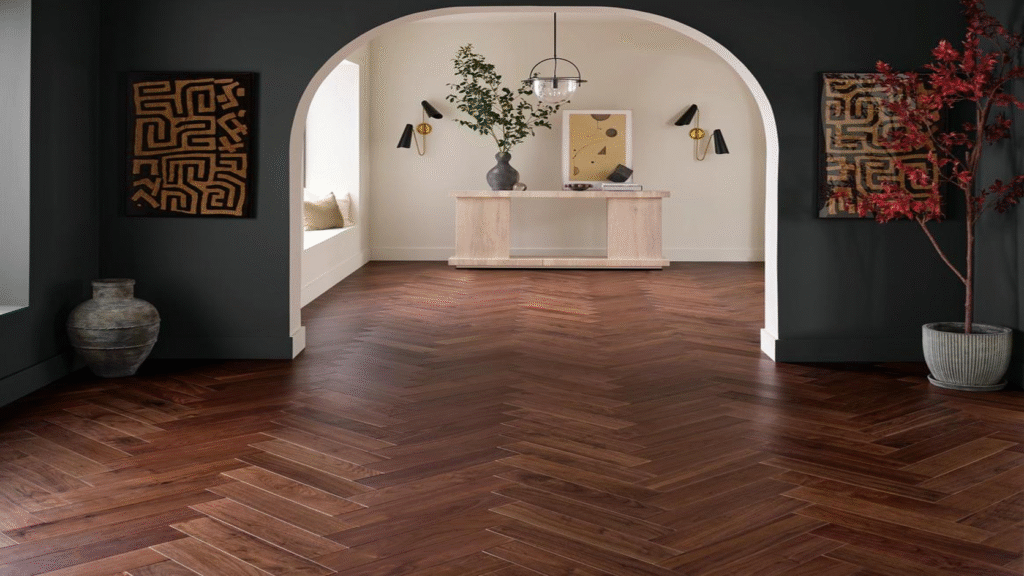
- Visual depth: Adds dimensionality that flat plank flooring can’t replicate
- Timeless value: A well-installed oak parquet floor rarely goes out of style
- Increases property value: Premium wooden flooring is a recognized value-add in resale and rental markets
- Design flexibility: Works across traditional, contemporary, and minimalist interiors
- Durability: Real oak parquet, properly maintained, can last for decades and be refinished multiple times
Common Mistakes to Avoid
- Choosing the pattern after the furniture layout is finalized. Pattern direction should be decided early — it affects how furniture and walkways feel in the space.
- Using a dark, dense pattern in a small, low-light room. This can make the room feel smaller and heavier instead of enhancing it.
- Ignoring subfloor preparation. An uneven subfloor will visibly distort geometric patterns like herringbone far more than it would a straight plank.
- Mixing too many pattern scales in adjoining rooms. Inconsistent flow between spaces breaks the sense of continuity that makes parquet feel intentional.
- Overlooking acclimatization. Real wood flooring needs to adjust to local humidity and temperature before installation — skipping this step is a leading cause of gaps and warping later.
Installation: What to Expect
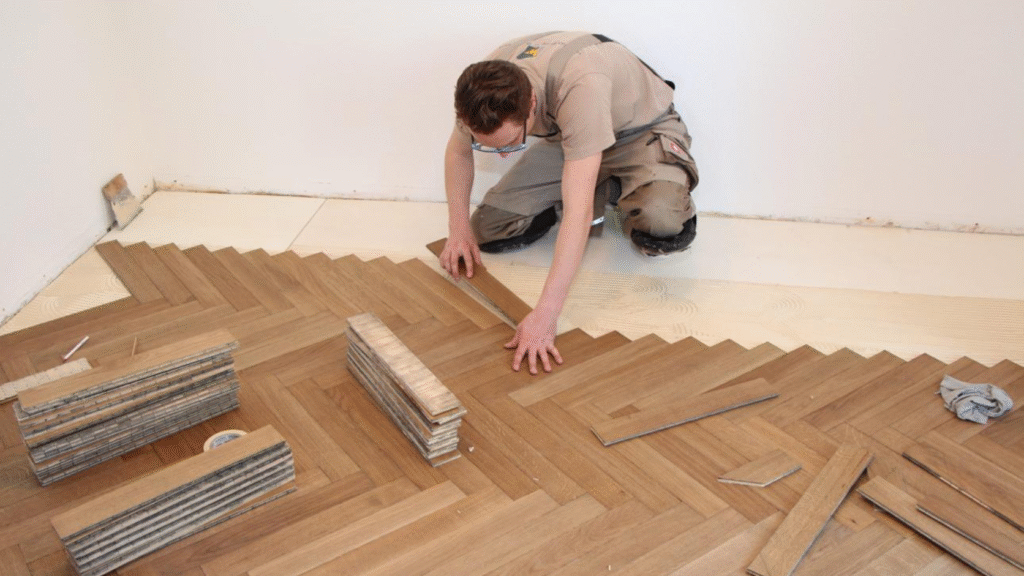
While every project varies, a professional parquet flooring installation generally follows this sequence:
- Site assessment & subfloor check — moisture levels, flatness, and structural readiness are evaluated.
- Wood acclimatization — planks/blocks are allowed to adjust to the room’s humidity and temperature for a set period.
- Layout planning — the installer maps the pattern direction relative to light sources, room shape, and entry points.
- Installation — pieces are laid, glued, nailed, or floated depending on the flooring type and subfloor.
- Sanding & finishing (for solid/site-finished parquet) — the surface is sanded level and sealed with the chosen finish.
- Final inspection — checking for gaps, level consistency, and pattern alignment.
Cost consideration: Parquet flooring typically costs more than standard plank flooring due to the labor-intensive cutting and laying process, especially for intricate patterns like chevron or Versailles. Engineered oak parquet offers a more budget-conscious route to the same visual effect without compromising on durability.
Maintenance Tips for Long-Lasting Parquet Floors
- Sweep or vacuum regularly to prevent grit from scratching the finish
- Use a slightly damp (never wet) mop — standing water is the biggest threat to real wood flooring
- Place felt pads under furniture legs to prevent dents along pattern joints
- Maintain stable indoor humidity (ideally 40–60%) to prevent expansion or gapping
- Refinish/sand every 7–10 years depending on foot traffic, to restore the original shine and protect the wood
Buying Guide: How to Choose the Right Parquet Flooring
When evaluating premium wooden flooring options, consider:
- Room function and light exposure — match pattern scale and wood tone to the room’s natural light
- Wood type — solid oak for maximum longevity and refinishing potential; engineered oak wood flooring for better stability in humid or fluctuating climates
- Finish — matte finishes hide scratches better; glossy finishes enhance light reflection
- Pattern complexity vs. budget — herringbone offers a strong visual impact at a more accessible cost than Versailles or intricate custom parquet
- Supplier expertise — work with a wooden flooring specialist who can guide pattern-to-room matching, not just sell material
This is where working with a dedicated flooring partner like OAKA Floors makes a measurable difference — pattern selection is treated as part of the design process, not an afterthought.
Conclusion
Parquet flooring is far more than a decorative choice — the pattern you select actively shapes how light moves through a room and how spacious it feels day to day. Whether it’s a fine herringbone in a compact bedroom or a bold chevron in an open living area, the geometry does real, measurable work on your interior.
If you’re planning a renovation or new build and want flooring that’s chosen with this kind of intent — not just picked from a catalogue — OAKA Floors’ team can help you match the right oak flooring pattern to your space, light, and lifestyle. Explore OAKA Floors’ premium wooden flooring collection to see oak and herringbone options suited to your home.
FAQ Section
Q1. What is parquet flooring made of?
Parquet flooring is typically made from hardwood, most commonly oak, cut into small blocks or fingers and arranged into geometric patterns such as herringbone or chevron.
Q2. Is parquet flooring the same as herringbone flooring?
No. Herringbone is one specific pattern used within the broader parquet flooring category, which also includes chevron, basket weave, and Versailles patterns.
Q3. Does parquet flooring make a small room look bigger?
Engineered oak wood flooring, with its cross-layered construction, handles humidity fluctuations better than solid wood, making it a practical choice for varied Indian climate zones.
Q4. Is oak wood flooring good for humid climates?
Engineered oak wood flooring, with its cross-layered construction, handles humidity fluctuations better than solid wood, making it a practical choice for varied Indian climate zones.
Q5. How long does parquet flooring last?
Well-maintained solid oak parquet flooring can last several decades and can be sanded and refinished multiple times over its lifespan.
Q6. Is parquet flooring more expensive than regular wooden flooring?
Generally yes, due to the precision cutting and labor-intensive installation required for geometric patterns, though engineered oak options can offer a more cost-effective alternative to solid wood parquet.
Q7. What is the best parquet pattern for a living room?
Herringbone and chevron are the most popular choices for living rooms, offering a strong visual statement while remaining versatile across interior styles.
Ready to Upgrade Your Floors?
Discover premium, climate-friendly flooring solutions with OAKA Floors. Explore our collection or connect with our experts to find the perfect flooring for your home or business.