
The Waterproof Wood Flooring Confusion
Why the “Best Flooring” Question Doesn’t Have One Answer
Most homeowners start their search typing “best wooden flooring for home” into Google, expecting a single winner. In reality, a floor that performs beautifully in a Delhi living room can warp within a year in a Mumbai kitchen. Humidity, foot traffic, sunlight exposure, and how a room is used all change what “best” means.
This is where residential wooden flooring services come in — not just selling planks, but assessing each room, the subfloor condition, local climate, and lifestyle before recommending a product. A good flooring partner treats your home as a set of micro-environments, not one uniform space.
At OAKA Floors, this room-by-room assessment is standard practice for every residential project — because the wrong wood in the wrong room is the single most common cause of flooring complaints in India.
There’s no single “best” wooden floor for a whole house — the right choice changes room by room. Solid or oak wood flooring suits living rooms and bedrooms where humidity is low and foot traffic is moderate. Engineered and hybrid wood flooring work better in kitchens, kids’ rooms, and semi-humid Indian climates because of their dimensional stability and moisture resistance. Professional residential wooden flooring services matter as much as the material itself — correct subfloor prep, acclimatisation, and installation determine whether a floor lasts 5 years or 25.
Types of Wooden Flooring: A Quick Overview
Before comparing rooms, it helps to understand the four broad categories available under wooden flooring today.
- Solid Wood Flooring: Milled from a single piece of timber (like solid oak). Offers the most authentic look and can be sanded/refinished multiple times, but is more sensitive to moisture and temperature swings.
- Engineered Wood Flooring: A real wood veneer bonded over cross-layered plywood. Far more dimensionally stable than solid wood, making it a practical choice for India’s fluctuating humidity.
- Oak Wood Flooring: Available in both solid and engineered formats. Prized for its strength, tight grain, and ability to take stains well — one of the most requested species for premium wooden flooring in Indian homes.
- Hybrid / Rigid Vinyl Wood Flooring: A modern alternative that combines a rigid waterproof core with a realistic wood-look top layer. It resists scratches and water, making it ideal for high-moisture or high-traffic zones.
| Flooring Type | Moisture Resistance | Durability | Best For | Relative Cost |
|---|---|---|---|---|
| Solid Wood | Low–Medium | High (with care) | Living rooms, bedrooms | High |
| Engineered Wood | Medium–High | High | Most residential rooms | Medium–High |
| Oak Wood (Solid/Engineered) | Medium | Very High | Living areas, staircases | High |
| Hybrid/Rigid Vinyl | Very High | Very High | Kitchens, kids’ rooms, humid climates | Medium |
Which Flooring Is Best for Every Room? A Room-by-Room Guide
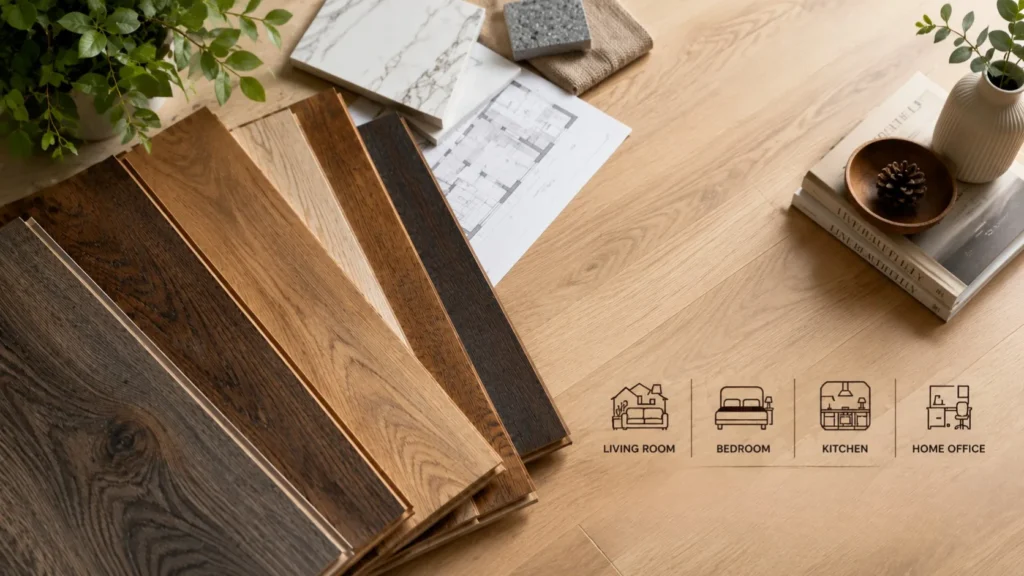
1. Living Room
The living room sees moderate to high foot traffic and is often the visual centrepiece of the home. Oak wood flooring or engineered wood in warm, natural tones works exceptionally well here, offering both durability and a premium finish that photographs well for resale value.
Recommended: Solid or engineered oak, wide-plank formats for an open, elegant look.
2. Bedrooms
Bedrooms have lower foot traffic and less moisture exposure, making them ideal for softer, warmer-toned wood species. Comfort underfoot matters more here than scratch resistance.
Recommended: Engineered wood or solid oak in matte finishes, which hide daily wear and feel warmer than high-gloss options.
3. Kitchen
Kitchens deal with spills, humidity, and constant foot traffic — the toughest combination for any wood floor. Traditional solid wood is a risky choice here.
Recommended: Hybrid/rigid vinyl wood flooring or fully sealed engineered wood with waterproof cores. This is one of the clearest cases where premium wooden flooring should be chosen for performance, not just appearance.
4. Kids’ Rooms and Play Areas
These spaces need floors that resist scratches, spills, and impact from toys and furniture, while still feeling warm and safe underfoot.
Recommended: Scratch-resistant hybrid wood flooring or engineered oak with a durable finish layer.
5. Staircases
Staircases are high-stress zones that need seamless, joint-free finishing to avoid visible breaks on the contours of each step — a detail that separates amateur installation from expert wooden flooring installation services.
Recommended: Engineered oak or hybrid flooring, professionally bent and shaped to follow stair contours without visible seams.
6. Home Office / Study
A calm, consistent surface with minimal glare works best for long working hours. Stability matters more than statement grain patterns.
Recommended: Engineered wood in mid-tone finishes; avoids excessive reflection from screens and overhead lighting.
7. Balconies and Semi-Covered Areas
Wood is not naturally suited to outdoor or semi-exposed conditions, but where covered balconies demand a wood look, only fully waterproof hybrid flooring should be considered.
Recommended: Waterproof rigid vinyl wood flooring only — never solid wood in this zone.
Oak Wood Flooring: Why It’s Still the Benchmark
Among all species used in wooden flooring India today, oak remains the most requested for good reason:
- Strength and hardness: Oak’s tight grain structure resists dents and daily wear better than many softer hardwoods.
- Finishing versatility: Oak takes stains and finishes evenly, allowing everything from light Scandinavian tones to deep walnut-like shades.
- Longevity: Solid oak floors, properly maintained, can be sanded and refinished multiple times over decades.
- Timeless resale value: Oak floors are widely recognised and tend to hold their value better than trend-driven finishes.
The trade-off is cost and moisture sensitivity, which is why engineered oak — real oak veneer over a stable plywood core — has become the practical middle ground for Indian homes with variable humidity.
What Goes Into Professional Wooden Flooring Installation Services
The material is only half the equation. Poor installation is responsible for the majority of flooring failures — buckling, gaps, and uneven surfaces — regardless of how premium the wood is. Reliable wooden flooring installation services typically include:
- Site assessment: Checking subfloor moisture levels, evenness, and room-specific conditions.
- Acclimatisation: Letting the wood adjust to indoor temperature and humidity for 48–72 hours before laying, to prevent post-installation expansion or contraction.
- Subfloor preparation: Levelling, moisture barriers, and underlayment suited to the flooring type.
- Precision laying: Correct expansion gaps at walls, proper plank alignment, and seamless transitions at doorways and staircases.
- Finishing and sealing: Edge sealing and trims to protect against dust, moisture, and movement.
Skipping any of these steps — even with high-quality premium wooden flooring — often leads to warping or squeaky boards within the first year.
Cost Factors for Residential Wooden Flooring in India
Flooring cost in the Indian market depends on several variables rather than a flat per-square-foot rate:
- Wood species and grade — oak and other premium hardwoods cost more than laminate-style alternatives.
- Solid vs engineered vs hybrid construction — engineered and hybrid formats are often more cost-effective without compromising durability.
- Plank size and pattern — wide planks and herringbone layouts cost more in material and labour.
- Subfloor condition — homes needing extensive levelling add to installation cost.
- Finish type — matte, oiled, and UV-cured finishes are priced differently.
- City and site logistics — transport and site access affect labour charges across Indian metros.
Rather than comparing raw price per square foot, it’s more useful to compare total cost of ownership — a slightly pricier engineered or hybrid floor that avoids replacement in 5 years is often the more economical wooden flooring decision over time.
Maintenance: Keeping Wooden Floors Looking New
- Sweep or vacuum regularly to prevent grit from scratching the surface.
- Wipe spills immediately, especially in kitchens and near entryways.
- Use furniture pads under heavy items to prevent dents.
- Avoid steam mops on solid or engineered wood — excess moisture damages the finish over time.
- Maintain indoor humidity between roughly 40–60% where possible, using AC or dehumidifiers in extreme seasons.
- Re-polish solid wood every few years depending on foot traffic, rather than waiting for visible damage.
Common Mistakes Homeowners Make When Choosing Wooden Flooring
- Choosing one flooring type for the entire home instead of matching material to each room’s conditions.
- Ignoring subfloor moisture testing, which is one of the leading causes of long-term floor failure.
- Prioritising price over installation quality, leading to premature repairs.
- Skipping acclimatisation to save installation time.
- Overlooking maintenance requirements before purchase, especially for households with pets or young children.
- Assuming all “wood flooring” is water-resistant, when only specific hybrid or sealed engineered products actually are.
Buying Guide: How to Choose the Right Wooden Flooring
- List your rooms and their conditions — humidity, sunlight, and foot traffic differ across the home.
- Match material to room, using the room-by-room guide above as a baseline.
- Set a realistic budget that includes installation, underlayment, and finishing — not just the wood itself.
- Request samples and view them in actual room lighting before deciding.
- Ask about warranty and after-sales support, particularly for engineered and hybrid products.
- Choose an installer, not just a supplier — ask specifically about their residential wooden flooring services process, not only product catalogues.
Why Homeowners Choose OAKA Floors
OAKA Floors works across premium wooden flooring, waterproof hybrid wood, and rigid vinyl plank solutions for Indian and Dubai residences, with a focus on room-specific recommendations rather than one-size-fits-all catalogues. From natural oak-inspired tones to deep, statement finishes, the collection is built to address the exact challenges outlined above — humidity in kitchens, durability on staircases, and warmth in living spaces — backed by installation teams trained to handle India’s variable climate conditions.
Conclusion
Choosing the right wooden floor isn’t about picking one trending material for the entire house — it’s about matching the right wood construction to each room’s humidity, traffic, and lifestyle demands. Oak wood flooring brings timeless strength to living spaces, engineered wood offers stability across most rooms, and hybrid wood flooring solves the moisture challenge in kitchens and high-traffic zones.
If you’re planning a home renovation or new build, a room-by-room consultation with a specialist in residential wooden flooring services — like OAKA Floors — can save years of maintenance headaches and help you get a floor that performs as well as it looks. Explore OAKA Floors’ wooden flooring collection to find the right match for every room in your home.
FAQ Section
Q1: Which wooden flooring is best for Indian homes?
Engineered wood and hybrid wood flooring generally perform best across most Indian homes because they resist the expansion and contraction caused by humidity swings better than solid wood, while still offering an authentic wood appearance.
Q2: Is oak wood flooring good for humid climates?
Solid oak can be sensitive to high humidity, but engineered oak — a real oak veneer over a stable plywood core — handles India’s humid and fluctuating climate significantly better while retaining oak’s natural look and strength.
Q3: Can wooden flooring be installed in kitchens and bathrooms?
Standard solid wood is not recommended for kitchens or bathrooms due to spill exposure. Waterproof hybrid or rigid vinyl wood flooring is the safer choice for these high-moisture rooms.
Q4: How long does residential wooden flooring installation take?
For an average-sized home, professional wooden flooring installation services typically take a few days to about two weeks, depending on room count, subfloor condition, and acclimatisation time.
Q5: What is the difference between solid and engineered wooden flooring?
Solid wood flooring is milled from a single piece of timber and can be refinished many times, while engineered wood uses a real wood veneer over a layered plywood core, offering greater dimensional stability at a comparable premium look.
Q6: How much does premium wooden flooring cost in India?
Cost varies by wood species, construction type (solid, engineered, or hybrid), plank size, and installation complexity, so it’s best to get a room-specific quote rather than rely on a single average price.
Q7: How do I maintain wooden flooring to make it last longer?
Regular sweeping, immediate spill cleanup, furniture pads, avoiding steam mops, and maintaining stable indoor humidity are the key habits that extend the life of any wooden floor.
Ready to Upgrade Your Floors?
Discover premium, climate-friendly flooring solutions with OAKA Floors. Explore our collection or connect with our experts to find the perfect flooring for your home or business.