
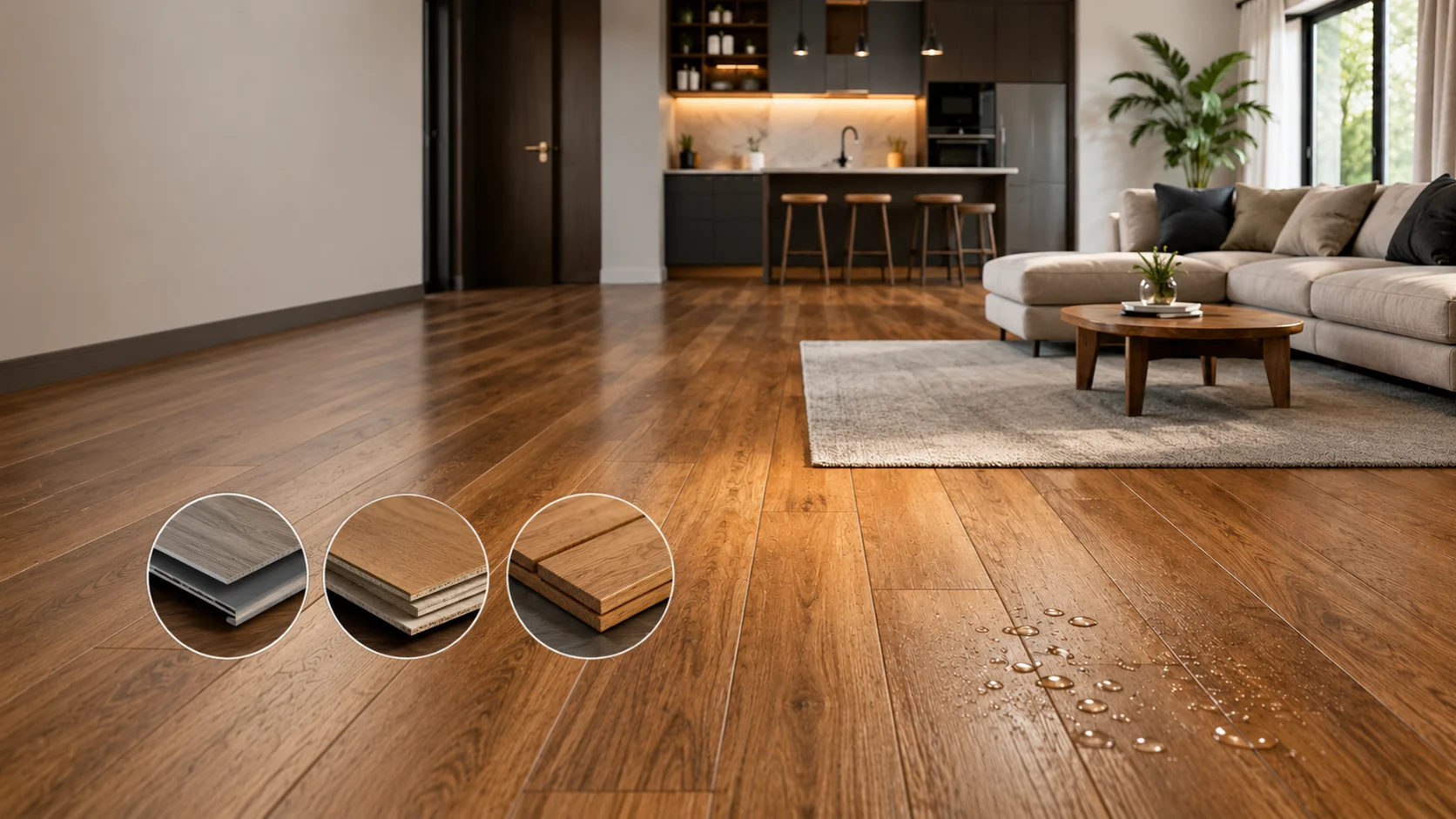
The Waterproof Wood Flooring Confusion
Search “waterproof wood flooring” and you’ll find dozens of brands making bold claims — but the truth is more nuanced than marketing copy suggests. Real wood, by its natural composition, absorbs moisture. What’s changed is the technology built around wood-look flooring, which now includes 100% waterproof cores that never contain actual timber at all.
At OAKA Floors, this is a question our design consultants field almost daily, especially from homeowners in humid or monsoon-prone regions across India, and from anyone flooring a kitchen, bathroom, or balcony. This guide breaks down exactly what “waterproof” means for each flooring type — SPC, engineered wood, and solid hardwood — so you can choose with confidence instead of guesswork.
No hardwood floor is 100% waterproof — but SPC (Stone Polymer Composite) flooring is genuinely waterproof, while engineered wood is only water-resistant, and solid hardwood is the most vulnerable to moisture. If you need true waterproof performance for kitchens, bathrooms, or humid Indian climates, SPC wood-look flooring is the safest choice. If you want the authentic look and feel of real wood with better moisture tolerance than solid hardwood, engineered wood flooring is a strong middle-ground option.
Is Wood Flooring Actually Waterproof? The Direct Answer
Here’s the straightforward, snippet-ready answer:
- Solid hardwood flooring — Not waterproof. Not water-resistant. Prolonged moisture causes warping, cupping, and staining.
- Engineered wood flooring — Water-resistant, not waterproof. It tolerates spills wiped up quickly but fails under standing water or humidity extremes.
- SPC wood flooring (Stone Polymer Composite) — 100% waterproof. It contains no organic wood fibers, so it cannot swell, rot, or absorb water at all.
So when people ask for “waterproof wood flooring,” what they usually need is wood-look flooring that is waterproof by construction — and that’s exactly what SPC and luxury vinyl flooring deliver.
Understanding the Three Flooring Types
1. Solid Hardwood Flooring
Solid hardwood is 100% natural timber, milled from a single piece of wood (oak, teak, walnut, etc.). It’s prized for its authenticity, longevity, and the way it ages and refinishes over decades.
Why it isn’t waterproof: Wood is hygroscopic — it naturally absorbs and releases moisture from the surrounding air. Even sealed and finished, hardwood expands when it absorbs water and contracts as it dries, which over time causes:
- Cupping (edges rise higher than the center)
- Buckling (planks lift off the subfloor)
- Warping and permanent staining
- Mould growth in humid, unventilated spaces
Solid hardwood performs best in dry, climate-controlled rooms — living rooms, bedrooms, and studies — and should generally be avoided in bathrooms, laundry areas, or ground-floor spaces prone to dampness.
2. Engineered Wood Flooring
Engineered wood flooring is built from multiple layers: a real hardwood veneer on top, bonded to cross-layered plywood or high-density fibreboard beneath. This layered, cross-grain construction gives it more dimensional stability than solid wood.
Water resistance, not waterproofing: Because the top layer is still genuine wood, engineered wood flooring can handle occasional humidity fluctuations and minor spills far better than solid hardwood — but it is not immune to water damage. Standing water, leaks left unattended, or consistently high humidity will still cause the veneer to swell or delaminate over time.
Engineered wood flooring is a popular choice across wooden flooring India projects because it balances a genuine wood aesthetic with better performance in India’s varied climate — from Ahmedabad’s dry heat to Mumbai’s humidity.
3. SPC Wood Flooring (Stone Polymer Composite)
SPC flooring is where “waterproof” stops being a marketing word and becomes a technical fact. SPC is a category of luxury vinyl flooring built with a rigid core made of limestone powder and stabilizers, topped with a high-resolution wood-look print layer and a protective wear layer.
Why SPC is genuinely waterproof:
- The core contains zero organic wood material — nothing to absorb water, swell, or rot.
- Layers are fused, not glued, eliminating seams where water could seep in and cause delamination.
- It can be installed in bathrooms, kitchens, basements, and even semi-outdoor covered areas.
SPC is a sub-category of vinyl plank flooring, alongside WPC (Wood Polymer Composite) and traditional LVT. Among these, SPC is generally the most dimensionally stable and the most water- and dent-resistant, making it the go-to choice when someone specifically searches for waterproof wood flooring.
Comparison Table: SPC vs Engineered Wood vs Solid Hardwood
| Feature | SPC Wood Flooring | Engineered Wood Flooring | Solid Hardwood Flooring |
|---|---|---|---|
| Waterproof rating | 100% waterproof | Water-resistant only | Not water-resistant |
| Suitable for bathrooms/kitchens | Yes | Not recommended | No |
| Real wood content | None (wood-look print layer) | Genuine wood veneer top layer | 100% solid wood |
| Durability (scratches/dents) | Very high | Moderate to high | Moderate (can be refinished) |
| Lifespan | 15–25 years | 20–30 years | 30–100 years (with refinishing) |
| Refinishable | No | Once, sometimes twice | Multiple times (up to 4–6) |
| Feel underfoot | Firm, slightly warmer with underlay | Warm, authentic wood feel | Warmest, most natural feel |
| Best climate fit | Humid & variable climates | Moderate humidity regions | Dry, climate-controlled interiors |
| Maintenance | Low — just sweep & damp mop | Low to moderate | Moderate — needs polishing/resealing |
| Indicative cost (India) | ₹150–₹350 per sq. ft. | ₹250–₹550 per sq. ft. | ₹400–₹900+ per sq. ft. |
| Ideal rooms | Kitchens, bathrooms, basements, commercial spaces | Living rooms, bedrooms, dining areas | Living rooms, studies, formal spaces |
Note: Prices vary by wood species, plank thickness, brand, and finish. Use these as indicative ranges for budgeting, not final quotes.
Where Each Flooring Type Actually Makes Sense
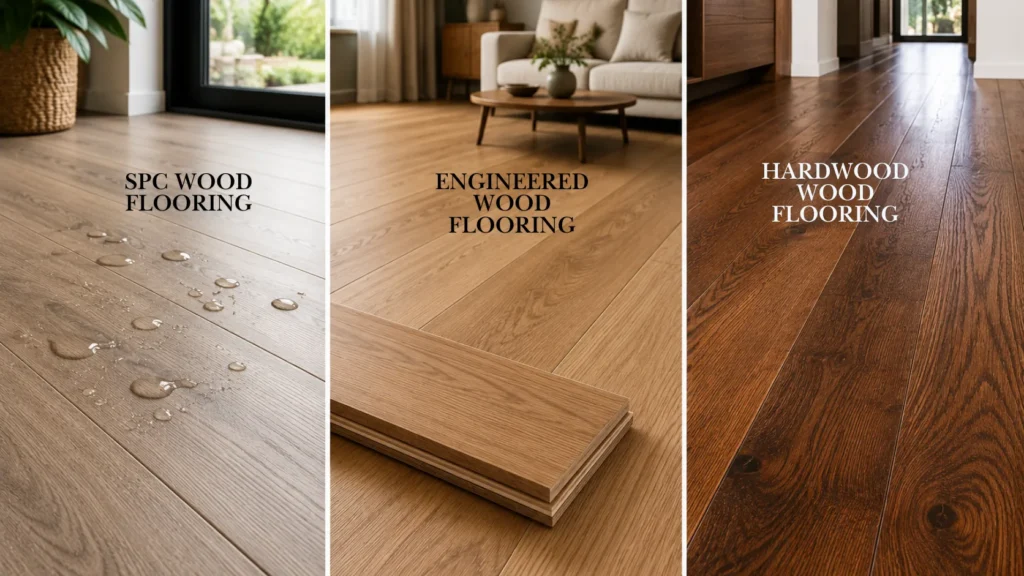
Choose SPC / Luxury Vinyl Flooring if:
- You want wood-look flooring for a bathroom, kitchen, or balcony
- You live in a humid or monsoon-heavy region
- You have pets, kids, or high foot traffic and want scratch/dent resistance
- You want a budget-friendly alternative to real wood with minimal maintenance
Choose Engineered Wood Flooring if:
- You want the authentic look, grain, and warmth of real wood
- You’re flooring living rooms, bedrooms, or dining spaces (not wet areas)
- You want better stability than solid hardwood in India’s variable humidity
- You’re open to professional resealing every few years
Choose Solid Hardwood Flooring if:
- You’re flooring a dry, climate-controlled space
- You want a floor that can be sanded and refinished for generations
- Long-term investment value and authenticity matter more than moisture tolerance
- You’re willing to invest in proper humidity control (AC, dehumidifiers) in the room
Installation Considerations for Waterproof Performance
Even the most waterproof flooring can underperform if installed incorrectly. Keep these points in mind:
- Subfloor moisture testing — Always test subfloor moisture levels before installing engineered wood or hardwood, especially on ground floors or over concrete slabs common in Indian construction.
- Expansion gaps — Wood-based floors need expansion gaps along the walls to accommodate natural movement; skipping this causes buckling.
- Sealed edges in wet zones — For SPC installed near wet areas, ensure edges along walls and cabinetry are properly sealed with silicone to block water ingress at the perimeter.
- Click-lock vs glue-down — SPC’s click-lock or fully bonded systems create a tighter water seal than floating engineered wood installations.
- Professional installation — Improper installation is one of the leading causes of “waterproof” floors failing prematurely — always use experienced installers, ideally through your flooring brand’s certified team.
Common Mistakes to Avoid
- Assuming “water-resistant” means “waterproof.” These terms are not interchangeable — read product specs carefully.
- Installing solid hardwood in bathrooms or kitchens without any moisture barrier or ventilation plan.
- Ignoring standing water. Even SPC should not be left submerged indefinitely near drains or grout lines that aren’t sealed.
- Skipping underlay. The right underlay improves acoustics, comfort, and in some cases, added moisture protection.
- Buying on price alone. Ultra-cheap vinyl or SPC products may use thinner wear layers, reducing durability and true waterproof performance.
- Not checking real-world reviews or samples before committing to a full-home order — always request a physical sample under your own lighting conditions.
Maintenance Guide by Flooring Type
| Task | SPC Flooring | Engineered Wood | Solid Hardwood |
|---|---|---|---|
| Daily cleaning | Sweep/vacuum | Sweep/vacuum | Sweep/vacuum |
| Wet mopping | Safe | Damp mop only, dry immediately | Avoid; use wood-specific cleaners |
| Refinishing | Not needed | Every 8–12 years (if veneer allows) | Every 7–10 years |
| Humidity control | Not required | Recommended (40–60% RH) | Essential (40–60% RH) |
| Furniture pads | Recommended | Recommended | Essential |
Wooden Flooring in the Indian Market Context
India’s climate diversity — from Ahmedabad’s dry heat and dust to coastal humidity in Mumbai and Chennai — makes flooring choice a genuinely regional decision, not a one-size-fits-all one.
For wooden flooring in Ahmedabad specifically, dry heat and dust are the bigger day-to-day concerns rather than humidity, which makes both engineered wood and SPC strong performers. However, homes with modular kitchens opening into semi-outdoor balconies, or bathrooms adjoining bedrooms, still benefit from SPC’s full waterproofing in those specific wet zones.
Across wooden flooring India projects more broadly, the trend has clearly shifted toward luxury vinyl flooring and SPC in kitchens, utility areas, and commercial spaces, while engineered wood and hardwood remain preferred for living and bedroom areas where the tactile, authentic wood experience matters most.
Expert Recommendation from OAKA Floors
Based on project experience across Indian homes and commercial spaces, our general guidance is:
- Wet-prone or high-traffic zones (kitchen, bathroom, balcony, basement): SPC wood flooring or luxury vinyl flooring
- Living rooms, bedrooms, studies: Engineered wood flooring for the best balance of authenticity and performance
- Formal, dry, climate-controlled interiors where longevity matters most: Solid hardwood flooring
Many homeowners don’t have to choose just one — a mixed-flooring strategy (SPC in wet areas, engineered wood or hardwood elsewhere) is increasingly common and gives you the best of both durability and design continuity. OAKA Floors’ design consultants can help map out which flooring type suits each room based on your household’s moisture exposure, footfall, and design goals.
Conclusion
Wood flooring, in its true sense, is never fully waterproof — but that doesn’t mean you have to compromise on the wood-look aesthetic in moisture-prone spaces. SPC wood flooring delivers genuine waterproof performance, engineered wood flooring offers a strong balance of authenticity and moisture resistance, and solid hardwood remains the gold standard for dry, long-term living spaces.
The right choice depends on where you’re flooring, how the space is used, and what matters most to you — durability, authenticity, or budget.
Not sure which flooring fits your space? Explore OAKA Floors‘ range of SPC, engineered wood, and hardwood flooring or request a free sample and consultation to find the right fit for every room in your home.
FAQ Section
Q1. Is any wood flooring truly 100% waterproof?
Real wood flooring — solid or engineered — is never 100% waterproof because it contains organic wood fibers that absorb moisture. Only wood-look alternatives like SPC flooring, which contain no real wood, are genuinely 100% waterproof.
Q2. What’s the difference between waterproof and water-resistant flooring?
Water-resistant flooring can handle brief exposure to moisture, like a quick spill wiped up promptly, but will be damaged by prolonged contact with water. Waterproof flooring can withstand standing water and humidity without swelling, warping, or structural damage.
Q3. Can engineered wood flooring be installed in a bathroom?
It’s not generally recommended. While engineered wood tolerates more humidity than solid hardwood, bathrooms involve frequent standing water and splashing that can still damage the wood veneer over time. SPC or luxury vinyl flooring is the safer choice for bathrooms.
Q4. Is SPC flooring as good-looking as real wood?
Modern SPC flooring uses high-resolution printing and embossed textures to closely replicate the grain, tone, and texture of real wood, making it visually difficult to distinguish at a glance while offering full waterproof performance.
Q5. Which is more affordable — SPC, engineered wood, or hardwood?
SPC and vinyl plank flooring are generally the most budget-friendly, followed by engineered wood, with solid hardwood typically being the most expensive due to material cost and finishing requirements.
Q6. Does SPC flooring feel cold or artificial underfoot?
With a quality underlay, SPC flooring feels comfortably firm and only slightly cooler than wood — a trade-off most homeowners find acceptable given its durability and waterproof performance.
Q7. How long does waterproof SPC flooring typically last?
Well-maintained SPC flooring typically lasts 15–25 years, depending on wear-layer thickness, foot traffic, and installation quality.
Q8. Is vinyl flooring the same as SPC flooring?
SPC is a type of vinyl flooring — specifically a rigid-core luxury vinyl flooring category. Other vinyl types include WPC (wood polymer composite) and traditional flexible LVT, each with different core compositions and performance levels.
Ready to Upgrade Your Floors?
Discover premium, climate-friendly flooring solutions with OAKA Floors. Explore our collection or connect with our experts to find the perfect flooring for your home or business.