
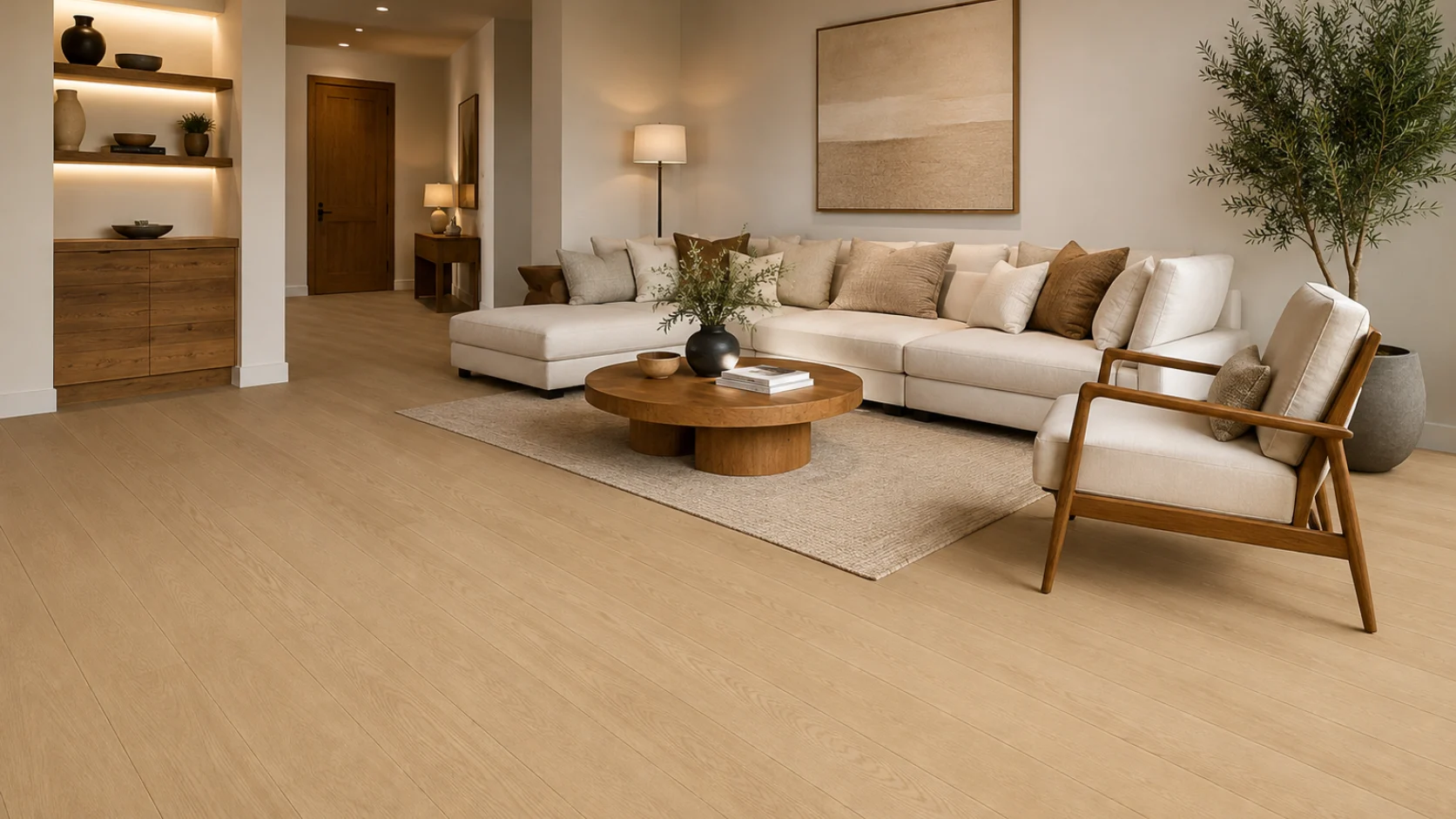
Walk into any newly renovated home, villa, or boutique office in India today, and there’s a good chance the floor beneath you tells a story of changing taste. For decades, narrow strip flooring — thin, repetitive boards laid in tight rows — was the default choice for anyone wanting a hardwood look. That’s shifting fast.
Architects and interior designers are increasingly specifying oak wood flooring in wider, longer boards, and homeowners are asking for it by name after seeing it in design magazines, Pinterest boards, and premium hospitality projects. The appeal isn’t just aesthetic. Wide-plank oak solves practical problems too — fewer seams to maintain, a more spacious feel in compact layouts, and a natural material that ages beautifully instead of looking dated.
This guide breaks down exactly why wide-plank oak flooring is trending, how it compares to standard-width boards, what it costs, how it’s installed and maintained in Indian conditions, and how to choose the right supplier — whether you’re renovating a home in Ahmedabad or sourcing through an oak wood flooring supplier in Dubai for a regional project. By the end, you’ll have a clear framework for deciding if bigger boards are the right call for your space.
Wide-plank oak wood flooring (boards typically 6 to 10 inches wide, compared to the traditional 2 to 3 inches) is trending because it shows off oak’s natural grain more dramatically, requires fewer seams for a cleaner look, and makes rooms feel larger and more luxurious. It’s a favoured choice for open-plan homes, villas, and premium commercial interiors across India, especially in cities like Mumbai, Delhi, Bengaluru, and Ahmedabad, where architects are moving away from narrow, repetitive strip flooring toward a more organic, high-end aesthetic.
What Is Wide-Plank Oak Flooring?
Wide-plank flooring refers to hardwood boards wider than the standard 2.25–3.25 inch strips used in classic parquet or strip flooring. Wide planks generally start at 5 inches and can go up to 10–12 inches, depending on the mill and the grade of oak used.
When this wider format is paired with oak — a hardwood prized for its strength, warm tones, and pronounced grain — you get a flooring style that reads as both rustic and refined. This is one of the reasons oak wood flooring remains one of the most requested hardwood species among Indian homeowners and designers today.
Why Oak Specifically Works Well in Wide Planks
Oak has a naturally bold, visible grain pattern with medallion-like figuring, especially in quarter-sawn and rift-sawn cuts. On a narrow 2-inch strip, that grain gets chopped into small repetitive segments. On a wide plank, the same grain flows uninterrupted, letting the wood’s natural character take centre stage.
Oak is also dimensionally stable relative to many other hardwoods, which matters more as boards get wider (wider boards move more with humidity changes, so species stability is critical).
Why Bigger Boards Are Trending Right Now
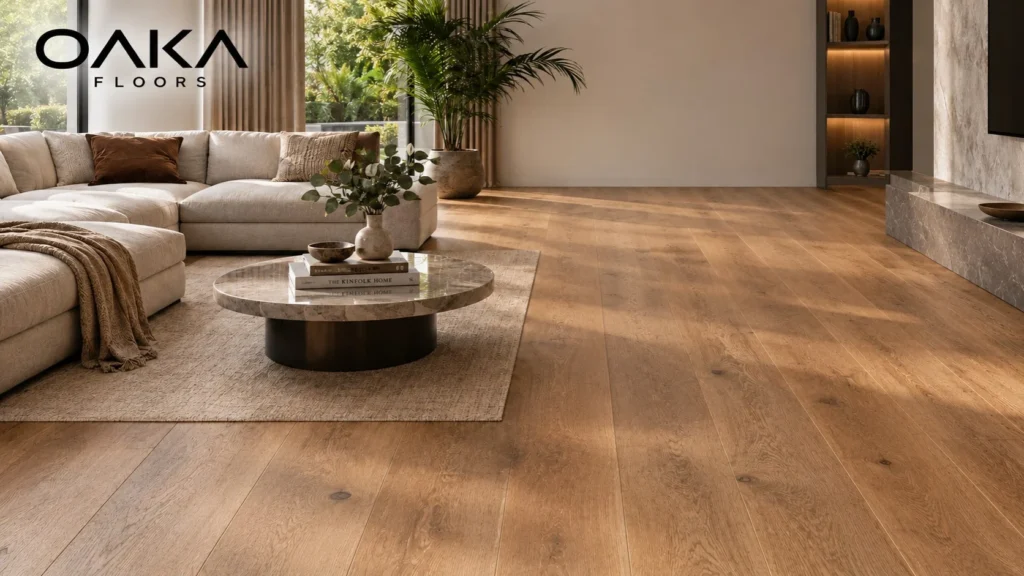
1. Fewer Seams, More Visual Flow
Wide planks cover more floor area per board, which means fewer joints. Fewer joints create a cleaner, more continuous visual line — something that photographs beautifully and feels more premium underfoot.
2. Rooms Look Larger
Interior designers commonly use wide-plank flooring to make compact rooms feel more spacious. The reduced number of grout-like seams tricks the eye into perceiving more open floor area, which is especially valuable in Indian apartments where square footage is at a premium.
3. Matches the Shift Toward Minimalist, Open-Plan Interiors
As Indian homes and offices move toward open-plan layouts, large glass frontages, and fewer partitions, flooring needs to “carry” more visual weight on its own. Wide-plank oak flooring fills that role without needing heavy furniture or rugs to break up a busy pattern.
4. Natural Wood Character Is Back in Demand
After years of engineered laminates mimicking wood grain, there’s a renewed appreciation for real, visible timber character — knots, mineral streaks, and colour variation. Wide boards showcase this authenticity far better than narrow strips.
5. Faster Installation, Fewer Boards
Counter-intuitively, wider boards can mean fewer total pieces to install for the same area, which can reduce labour time — a practical benefit contractors appreciate on large projects.
Wide-Plank vs Standard-Width Oak Flooring: A Comparison
| Feature | Wide-Plank Oak (5″–10″) | Standard Strip Oak (2″–3″) |
|---|---|---|
| Visual Impact | Bold, continuous grain, modern-rustic look | Traditional, uniform, classic look |
| Seams per sq. ft. | Fewer seams | More seams |
| Room Perception | Makes spaces feel larger and open | Can visually break up smaller rooms |
| Dimensional Movement | Slightly more sensitive to humidity swings | More stable, less noticeable movement |
| Best Suited For | Living rooms, villas, open-plan homes, offices | Bedrooms, hallways, high-traffic corridors |
| Installation Speed | Generally faster (fewer boards per sq. ft.) | Slower, more boards to lay |
| Typical Cost | Slightly higher due to milling & grading | More economical |
| Design Style | Contemporary, Scandinavian, industrial-luxe | Classic, heritage, colonial interiors |
Cost of Wide-Plank Oak Wood Flooring in India
Pricing for premium wooden flooring in India depends on the plank width, grade, finish, and whether it’s solid or engineered oak. As a general guide:
- Engineered wide-plank oak: More budget-friendly, better suited to Indian climate variability, and easier to install over existing subfloors.
- Solid wide-plank oak: Higher cost, longer lifespan, can be sanded and refinished multiple times over decades.
Wider boards typically cost more per square foot than narrow strips because wider, clear (knot-free or feature-graded) oak boards are harder to mill consistently. For an accurate, project-specific quote, it’s best to consult a specialised oak wood flooring supplier in Dubai or India who can assess your subfloor, room size, and finish preferences.
Installation: What to Know Before You Commit
Subfloor Preparation Matters More With Wide Planks
Because wide boards cover more surface area, any unevenness in the subfloor becomes more visible. A flat, moisture-tested subfloor is non-negotiable.
Acclimatisation Is Critical in Indian Climates
Oak — like all hardwood — expands and contracts with humidity. In India’s varied climate (coastal humidity vs. dry northern winters), wide planks should be acclimatised to the room’s conditions for several days before installation to reduce the risk of gapping or cupping.
Choose the Right Installation Method
- Nail-down or staple-down: Common for solid wide-plank oak over wooden subfloors.
- Glue-down: Preferred for engineered wide-plank oak on concrete subfloors, common in Indian apartments.
- Floating installation: Suitable for some engineered oak systems, especially in renovation projects.
Common Mistakes to Avoid
- Skipping acclimatisation before installation.
- Installing over a subfloor with residual moisture.
- Ignoring expansion gaps around the room’s perimeter.
- Choosing a width without checking your HVAC/humidity control setup.
- Selecting a supplier without asking for grading, moisture-content certification, or finish warranty details.
Maintenance Tips for Wide-Plank Oak Floors
- Sweep or vacuum regularly to prevent grit from scratching the finish.
- Use a slightly damp (not wet) mop — standing water is oak flooring’s biggest enemy.
- Maintain indoor humidity between roughly 40–60% where possible to minimise seasonal movement.
- Use felt pads under furniture legs.
- Re-coat the finish every few years depending on foot traffic, rather than waiting for visible wear.
Pros and Cons of Wide-Plank Oak Flooring
Pros
- Dramatic, natural grain display
- Fewer seams for a cleaner look
- Makes smaller spaces feel larger
- Timeless yet contemporary appeal
- Increases property value and buyer appeal
Cons
- Slightly higher cost than narrow strips
- More sensitive to humidity fluctuations if not properly acclimatised
- Requires a well-prepared, flat subfloor
- Fewer boards mean each imperfection is more noticeable
Buying Guide: How to Choose the Right Wide-Plank Oak Flooring
- Decide between solid and engineered oak based on your subfloor and climate.
- Check the grading — clear/select grades show minimal knots; rustic/character grades embrace natural variation.
- Confirm plank width and length — wider, longer planks generally cost more but deliver a bigger visual impact.
- Ask about finish type — UV-cured oil, matte lacquer, or hardwax oil each affect maintenance and appearance differently.
- Verify moisture content and certification, especially when sourcing engineered oak suited to Indian conditions.
- Work with an established supplier experienced in both residential and commercial-scale projects — this is where a trusted name in wooden flooring India makes a real difference in long-term satisfaction.
OAKA Floors works with architects, interior designers, and homeowners across India to source and install oak flooring suited to local climate conditions, offering guidance from plank selection through to finishing. Floors’ range of premium wooden flooring options and talk to their installation team about your home’s specific conditions before you buy.
Conclusion
Wide-plank oak wood flooring isn’t just a passing design trend — it reflects a real shift toward interiors that feel open, natural, and effortlessly premium. With fewer seams, bolder grain display, and a timeless finish, it’s easy to see why architects and homeowners across India are choosing bigger boards for their next project.
If you’re planning a renovation or new build and want to explore oak flooring options suited to your space and climate, OAKA Floors can help you compare widths, grades, and finishes to find the right fit. Get in touch with OAKA Floors to request samples or a project consultation.
FAQ Section
What width is considered “wide-plank” for oak flooring?
Wide-plank oak flooring generally starts at 5 inches wide and can go up to 10–12 inches, compared to traditional strip flooring at 2–3 inches.
Is wide-plank oak flooring more expensive than standard oak flooring?
Yes, typically. Wider boards require more precise milling and higher-grade timber to minimise defects, which increases the cost per square foot compared to standard-width oak flooring.
Does wide-plank oak flooring work well in Indian climate conditions?
Yes, when properly acclimatised and installed — especially with engineered oak constructions designed to handle humidity fluctuations better than solid wood in extreme climates.
Is engineered oak flooring as good as solid oak flooring?
Engineered oak offers better dimensional stability in variable climates and can often be installed in more locations (including over concrete), while solid oak offers a longer refinishing lifespan. The right choice depends on the project and subfloor.
How long does oak wood flooring typically last?
With proper care, solid oak flooring can last 50+ years and be refinished multiple times; engineered oak typically lasts 20–40 years depending on wear-layer thickness and maintenance.
Where can I buy premium wide-plank oak flooring in India or Dubai?
Suppliers like OAKA Floors offer premium wooden flooring solutions, including wide-plank oak, for both residential and commercial projects across Indian cities and act as a reliable oak wood flooring supplier in Dubai for regional projects as well.