
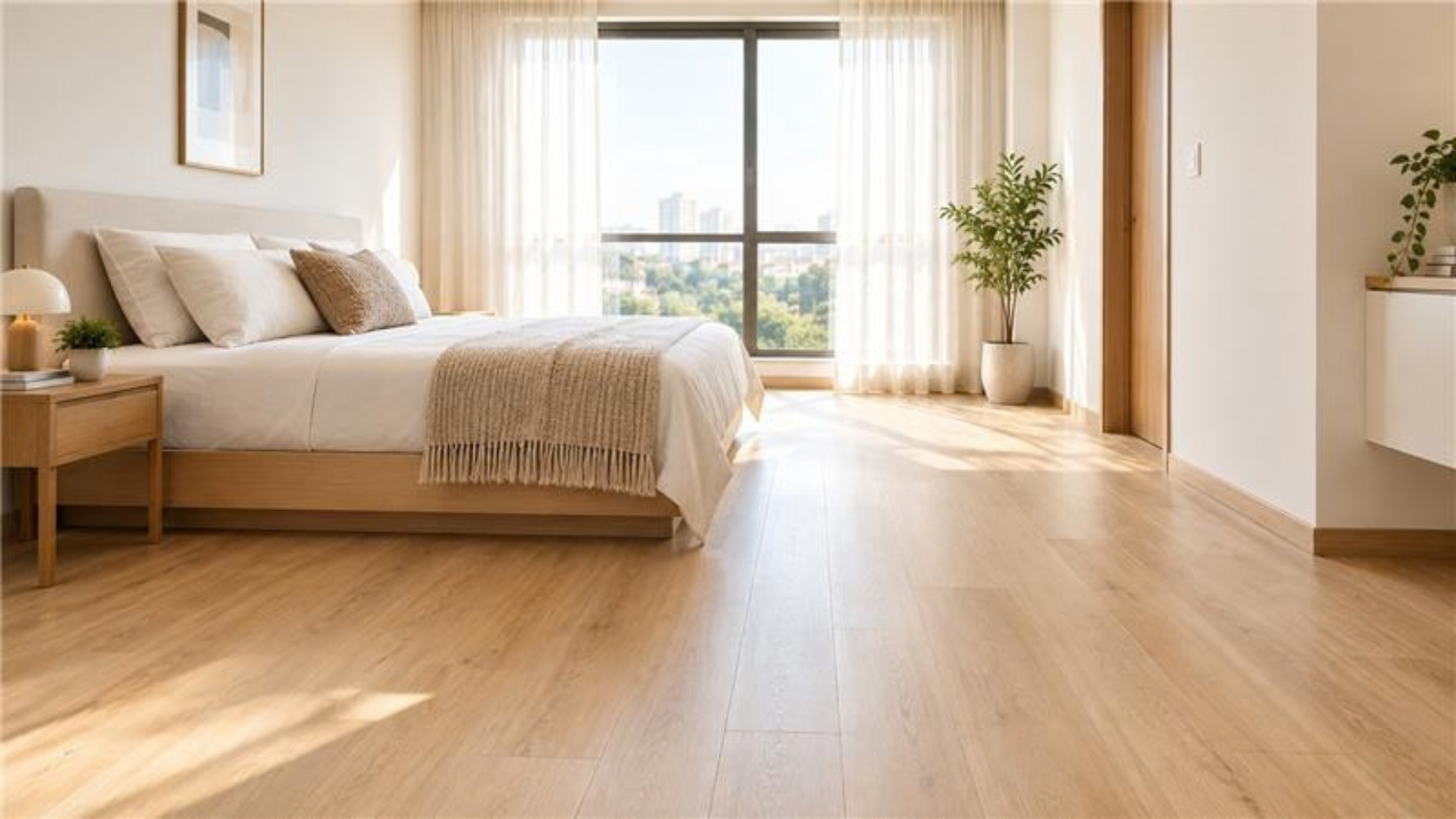
Walk into any small apartment or compact bedroom, and you’ll notice something interesting: the floor is doing more work than you think. Furniture, paint, and lighting get most of the credit for how “big” a room feels — but flooring is often the single biggest visual lever homeowners overlook.
At OAKA Floors, we’ve worked with hundreds of Indian homeowners squeezing style out of 250–600 sq. ft. apartments in cities like Mumbai, Bengaluru, and Gurugram. The pattern is consistent: the right flooring choice — color, plank size, laying pattern, and finish — can make a room feel 15–20% more spacious without moving a single wall.
This guide breaks down exactly how flooring affects perceived space, which materials work best (with a focus on luxury vinyl flooring, oak flooring, and herringbone flooring), real cost ranges, installation tips, and mistakes to avoid.
The fastest way to make a small room look bigger is to choose light-toned, large-format flooring — such as luxury vinyl flooring or wide-plank oak flooring — and lay it in a diagonal or herringbone pattern with minimal transitions between rooms. Light flooring reflects more natural light, fewer grout lines and seams reduce visual clutter, and a continuous floor plane tricks the eye into reading the space as larger and more open. Matte, low-sheen finishes and matching skirting boards to the floor color further enhance this effect.
Why Flooring Affects How Big a Room Feels
Before jumping into product choices, it helps to understand the psychology and physics behind it.
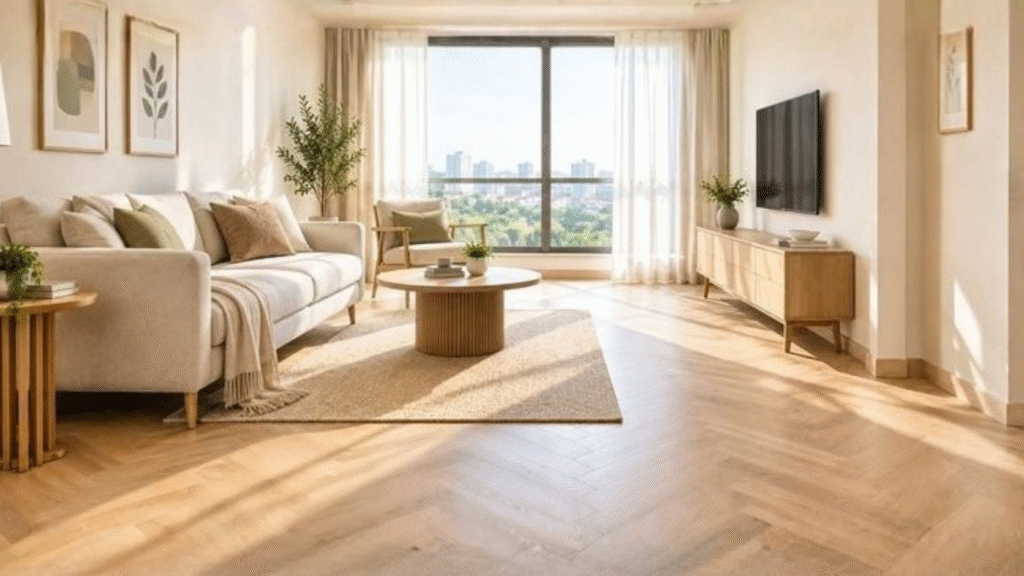
- Color and light reflection: Light-colored floors bounce more ambient light around a room, reducing shadows that make corners feel cramped.
- Continuity: When the same flooring runs from one room into the next (or into a balcony/hallway), the eye doesn’t register a “stop point,” so the whole area reads as one larger zone.
- Plank orientation: Long planks laid in the direction of the room’s longest wall visually stretch the space.
- Pattern illusion: Diagonal and herringbone layouts create movement that pulls the eye outward, making boundaries feel farther away.
- Fewer visual breaks: Large-format tiles or planks with minimal grout/seam lines reduce the “chopped up” look that busy patterns create.
This is the same principle interior designers use when they say a room “breathes” — flooring sets the visual foundation every other design choice sits on.
Best Flooring Types to Make a Small Room Look Bigger
1. Luxury Vinyl Flooring (LVF) — Best All-Rounder
Luxury vinyl flooring is one of the most effective and practical choices for small Indian homes. It replicates the exact look of natural wood or stone but is engineered to handle humidity, foot traffic, and budget constraints far better than solid timber.
Why it works for small rooms:
- Available in light oak, ashwood, and greige tones that maximize light reflection
- Manufactured in long, wide planks that elongate narrow rooms
- Thin profile allows seamless transitions between rooms without awkward height differences
- 100% waterproof, making it ideal for kitchens, balconies, and bathrooms in compact homes
Best for: Apartments, rental homes, kids’ rooms, kitchens, and any space where budget and durability matter as much as looks.
2. Vinyl Plank Flooring — Budget-Friendly Space Expander
Vinyl plank flooring is a specific format of LVF designed to mimic hardwood strips. Its narrow, elongated shape is particularly effective in small bedrooms and hallways.
- Plank widths of 150–180mm with realistic wood-grain texture create a natural elongation effect
- Click-lock installation means no glue mess and faster turnaround
- Available in light “Scandinavian oak” and “whitewashed” finishes that Indian designers now widely recommend for compact homes
3. Wooden Flooring & Oak Flooring — Timeless and Premium
Wooden flooring, particularly oak flooring, brings warmth without visually heavying a room — as long as the tone stays light to mid-range.
Premium wooden flooring in natural or honey-oak shades:
- Reflects light better than dark walnut or mahogany tones
- Has natural grain variation that adds subtle depth without clutter
- Increases resale value — a strong consideration for Indian homeowners in metro cities
Caution: Dark oak or heavily distressed wood finishes can make a small room feel enclosed. Stick to lighter stains for space-maximizing results.
4. Herringbone Flooring — Pattern That Expands Space
Herringbone flooring arranges rectangular planks in a distinctive zigzag “V” pattern. Contrary to intuition, a busier pattern can actually make small rooms feel larger when planks are light-colored, because the diagonal lines guide the eye across the full width of the room rather than stopping at a wall.
- Best laid diagonally to the room’s main sightline (e.g., from the entrance door)
- Works exceptionally well in narrow rooms, hallways, and box-shaped bedrooms
- Available in both engineered wood and luxury vinyl herringbone formats — the latter being more practical for Indian humidity levels
5. Parquet Flooring — Classic Elegance for Compact Interiors
Parquet flooring uses geometric wood block patterns (chevron, basketweave, herringbone) to add visual interest. In small rooms, a fine-scale parquet pattern in light oak or maple tones can add texture without overwhelming the space — larger, chunkier parquet blocks tend to do the opposite.
6. Waterproof Wood Flooring — Practical for Small, Multi-Use Rooms
Many small Indian homes use one room for multiple purposes — a bedroom that doubles as a study, or a living room next to an open kitchen. Waterproof wood flooring (engineered or SPC-core vinyl) allows a single, continuous light-toned floor to run through wet and dry zones alike, reinforcing the “one big space” illusion without worrying about moisture damage near kitchens or balconies.
Flooring Comparison Table: Which Option Fits Your Small Room?
| Flooring Type | Space-Enlarging Effect | Water Resistance | Best Rooms | Maintenance |
|---|---|---|---|---|
| Luxury Vinyl Flooring | High (light tones, large format) | Excellent (100% waterproof) | Bedrooms, kitchens, living rooms | Low |
| Vinyl Plank Flooring | High (elongated planks) | Excellent | Bedrooms, hallways | Low |
| Oak Flooring | Medium–High (if light-toned) | Moderate (needs sealing) | Living rooms, bedrooms | Medium |
| Premium Wooden Flooring | Medium (depends on stain) | Low–Moderate | Formal living areas | Medium–High |
| Herringbone Flooring | Very High (pattern illusion) | Depends on material used | Hallways, box bedrooms | Medium |
| Parquet Flooring | Medium–High (fine patterns) | Low–Moderate | Living rooms, studies | Medium–High |
| Waterproof Wood Flooring | High (continuous flow) | Excellent | Multi-use rooms, kitchens | Low |
Step-by-Step: How to Choose Flooring for a Small Room
- Measure natural light first. North-facing or low-light rooms need lighter flooring tones than sun-drenched south-facing rooms.
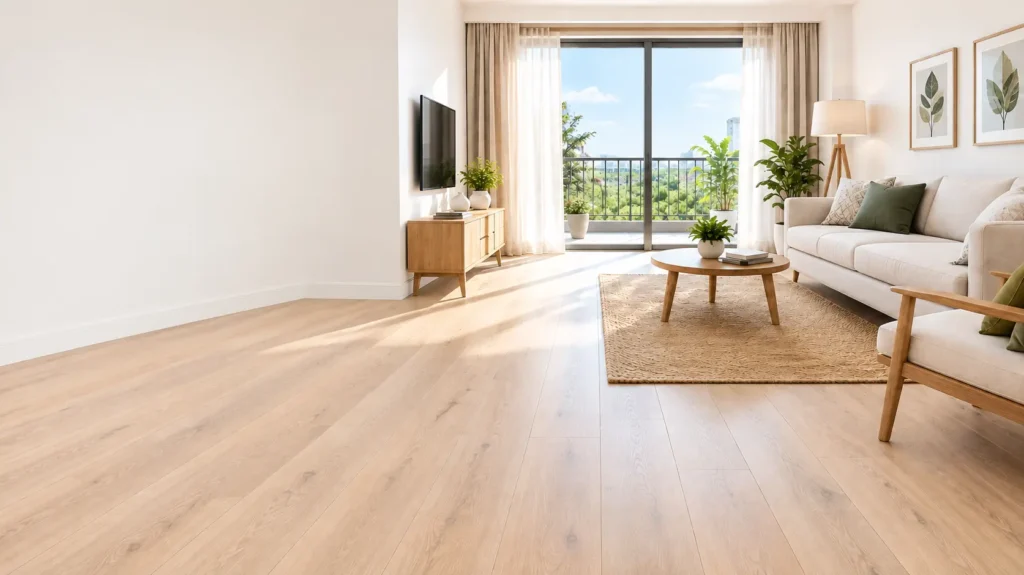
- Pick your plank direction. Run planks parallel to the longest wall or toward the main window to stretch the room visually.
- Choose a light, warm-neutral shade. Think honey oak, whitewashed ash, or soft greige — avoid deep walnut, wenge, or high-gloss black.
- Decide on pattern. Straight-lay for simplicity and budget; herringbone or diagonal parquet for a designer-level space illusion.
- Match skirting to the floor, not the wall. This removes a visual “stop line” at the base of the walls, making the room boundary feel less defined.
- Keep flooring consistent across adjoining spaces. Avoid switching materials or colors between a small bedroom and its attached balcony or passage.
- Choose waterproof wood flooring or luxury vinyl flooring for multi-use or humid rooms to maintain consistency without damage risk.
Installation Considerations
- Luxury vinyl flooring and vinyl plank flooring use click-lock or glue-down installation, typically completed in 1–2 days for a standard Indian bedroom (100–150 sq. ft.), with minimal dust and no curing time.
- Oak flooring and premium wooden flooring (solid or engineered) require subfloor leveling, acclimatization of the wood (48–72 hours in the room before installation), and professional fitting — usually 3–5 days.
- Herringbone and parquet flooring take longer due to precise cutting and pattern alignment — allow extra labor time compared to straight-lay installation.
- Always request a moisture and subfloor level check before installation, especially in older Indian apartments where uneven concrete slabs are common.
Pros & Cons Overview
Luxury Vinyl / Vinyl Plank Flooring
- ✅ Waterproof, budget-friendly, easy maintenance, realistic wood look
- ❌ Not as high resale value as solid wood; can dent under very heavy furniture without protective pads
Oak / Premium Wooden Flooring
- ✅ Timeless appeal, adds real estate value, natural material warmth
- ❌ Higher cost, sensitive to humidity and water, needs periodic refinishing
Herringbone / Parquet Flooring
- ✅ Strong design impact, excellent space illusion, adds character
- ❌ Higher installation cost and time; pattern can look busy if colors are too dark or contrasty
Common Mistakes to Avoid
- Using dark or high-contrast flooring in a small room — it visually shrinks the space, no matter how premium the material.
- Mixing multiple flooring types across a small apartment, which breaks visual continuity.
- Choosing high-gloss finishes, which can create glare and make uneven walls more noticeable.
- Oversized plank or tile patterns in very small rooms — a 6-inch narrow plank often works better than an extra-wide 10-inch plank in a cramped space.
- Ignoring the skirting board color, which is one of the easiest fixes for a seamless, larger-looking floor line.
Expert Recommendation
If you’re optimizing purely for the “bigger room” effect combined with real-world Indian living conditions (humidity, budget, and durability), light-toned luxury vinyl flooring or vinyl plank flooring in a straight or herringbone layout offers the best balance of visual impact, waterproofing, and cost. For homeowners prioritizing long-term value and willing to invest more, light oak flooring or premium wooden flooring remains an excellent choice, particularly in living rooms and bedrooms with good ventilation.
At OAKA Floors, our design consultants regularly guide clients through exactly this kind of light-vs-pattern-vs-material decision based on room dimensions, natural light, and lifestyle — because the “right” flooring for a small room is rarely a one-size-fits-all answer.
FAQ Section
Q1. Does light flooring really make a small room look bigger?
Yes. Light-toned flooring reflects more natural and artificial light around a room, reducing shadows and visual weight. This creates an airier, more expansive feel compared to dark flooring, which tends to visually shrink a space.
Q2. Is luxury vinyl flooring good for small bedrooms?
Yes. Luxury vinyl flooring is thin, available in light wood tones, waterproof, and comes in large-format planks — all of which contribute to a more spacious look while remaining budget-friendly and low-maintenance for small bedrooms.
Q3. Which is better for small rooms: herringbone or straight-lay flooring?
Both work well, but for different reasons. Straight-lay flooring in the direction of the longest wall elongates the room simply and affordably. Herringbone flooring uses diagonal pattern movement to create a stronger designer effect, but should be paired with light-colored planks for the best space-enlarging result.
Q4. Does the direction of the flooring planks matter in a small room?
Yes. Laying planks parallel to the room’s longest wall or toward the main light source visually stretches the space. Laying planks across the shorter width can make the room feel narrower.
Q5. Is oak flooring suitable for small apartments in India?
Yes, particularly in light or natural oak tones. Oak flooring adds warmth and long-term value, though homeowners in humid coastal regions should consider engineered oak or waterproof wood flooring over solid oak for better moisture resistance.
Q6. What is the most cost-effective flooring for making a small room look bigger?
Vinyl plank flooring and luxury vinyl flooring typically offer the best cost-to-impact ratio, combining light wood-effect finishes, waterproofing, and large-format planks at a fraction of the cost of solid wood or herringbone parquet.
Q7. Should skirting boards match the wall or the floor in a small room?
For a small room, matching skirting boards to the floor color (rather than the wall) removes a visual break at the base of the walls, making the floor plane appear larger and more continuous.
Q8. Which flooring is better for a home with pets?
SPC flooring is generally more pet-friendly due to its scratch resistance and waterproof surface, which makes cleaning up accidents and reducing paw-scratch damage much easier than with wood.