
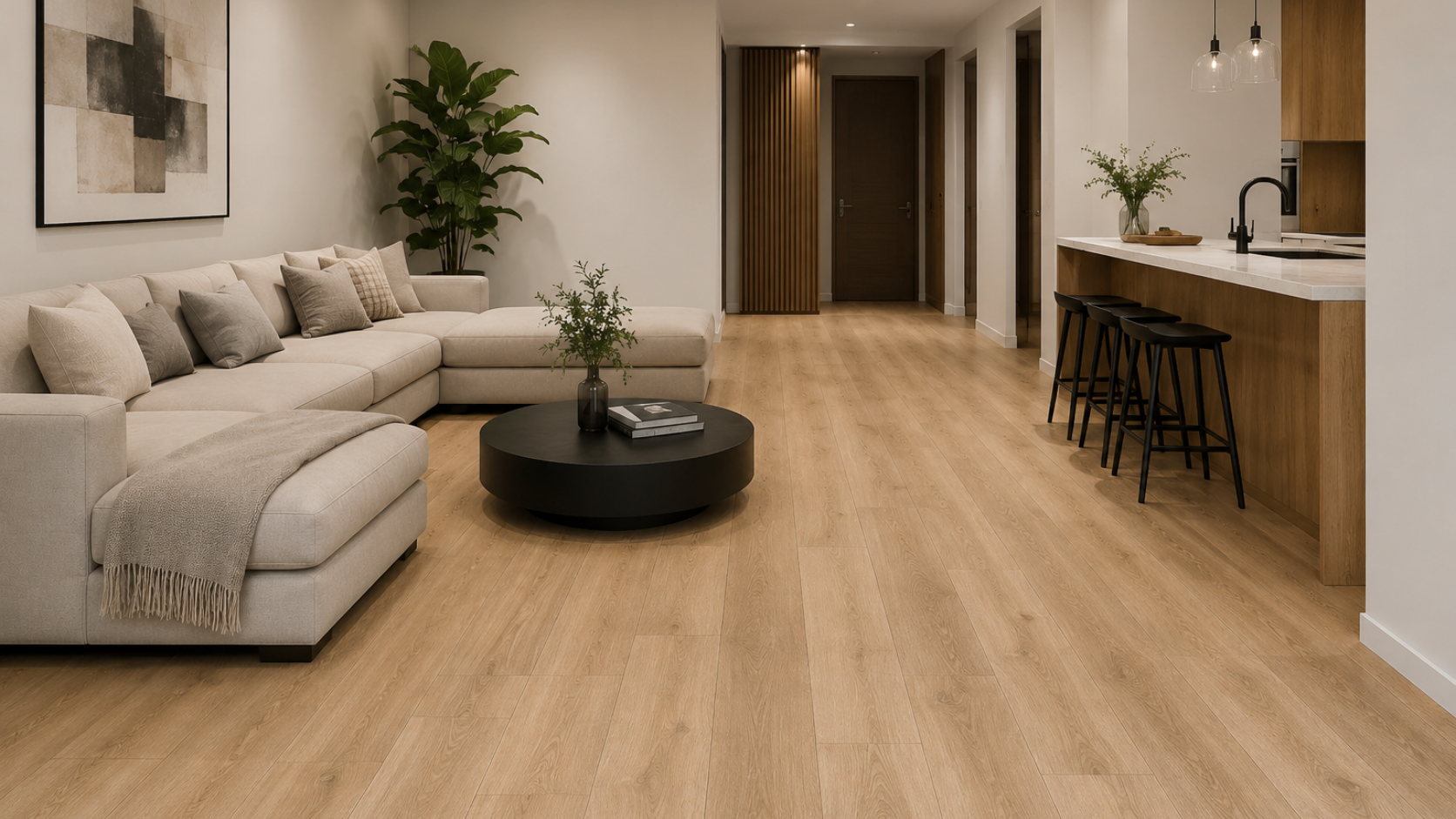
Walk into any recently renovated apartment in Mumbai, a boutique café in Bengaluru, or a designer villa in Gurugram, and there’s a good chance the floor underfoot isn’t solid wood at all — it’s vinyl plank flooring. Over the last few years, this material has quietly become the go-to choice for interior designers working on modern homes, and it’s not a trend built on hype. It’s built on performance.
This shift makes sense once you look at what designers actually need to deliver: a floor that looks like premium wood, survives Indian humidity and daily wear, fits realistic budgets, and doesn’t demand months of maintenance planning. Vinyl plank flooring checks every one of those boxes in a way traditional hardwood often can’t.
In this guide, we’ll break down exactly why designers are making this switch, how vinyl plank flooring compares to other options, what it costs, how it’s installed, and what to check before you buy — with practical, real-world context for Indian homes.
What Is Vinyl Plank Flooring?
Vinyl plank flooring is a synthetic flooring material engineered to replicate the look of natural wood while offering significantly better resistance to water, scratches, and daily wear. Each plank is built in layers — typically a wear layer, a printed design layer that mimics wood grain, and a rigid or flexible core — which is what gives it both realistic aesthetics and structural durability.
The category most designers refer to today is luxury vinyl flooring (LVF), sometimes called luxury vinyl plank (LVP). It’s a step above basic vinyl sheet flooring, offering thicker wear layers, more realistic textures, and better long-term performance.
Why Do Interior Designers Prefer Vinyl Plank Flooring?
Vinyl plank flooring is a multi-layered, waterproof, wood-look flooring solution that offers the appearance of natural hardwood while being more durable, cost-effective, and easier to maintain. It installs faster than traditional wood flooring, resists moisture and daily wear, and is available in a wide range of realistic wood finishes. These advantages make it one of the most recommended flooring choices for modern residential and commercial interiors.
Interior designers frequently specify vinyl plank flooring because it combines premium aesthetics with waterproof performance, low maintenance, quick installation, and long-term durability—making it ideal for contemporary homes, offices, retail spaces, and hospitality projects.
Why Interior Designers Are Choosing Vinyl Plank Flooring
1. It Delivers a Premium Look Without the Premium Risk
Modern interior design leans heavily on warm, natural textures — and wood-look flooring is central to that aesthetic. High-resolution printing and embossed textures now allow vinyl planks to replicate the grain, knots, and color variation of oak, walnut, and teak so convincingly that clients often can’t tell the difference by sight or touch.
Designers get the visual warmth of premium wooden flooring without worrying about how a natural material will react to a client’s specific home conditions — sunlight exposure, kitchen spills, or a monsoon-prone location.
2. Waterproof Performance Solves a Real Indian Problem
Humidity, monsoon dampness, and frequent mopping are daily realities in most Indian homes. Solid wood flooring expands, contracts, and can warp under these conditions unless it’s meticulously maintained.
Waterproof wood flooring in vinyl plank form uses a rigid core (SPC or WPC) that doesn’t absorb moisture, making it suitable for kitchens, bathrooms, balconies, and ground-floor spaces where traditional hardwood is a genuine risk. This single feature is often the deciding factor for designers working in coastal cities or homes with pets and young children.
3. Durability That Matches Real Family Life
Designers are ultimately accountable for how a space performs after handover — not just how it looks on installation day. Vinyl plank flooring‘s wear layer resists:
- Scratches from furniture movement and pet claws
- Dents from dropped objects
- Fading from UV exposure
- Stains from spills and everyday use
This durability means fewer callbacks, fewer client complaints, and a floor that still looks new years later — a major reason designers trust it for high-traffic homes.
4. Faster, Cleaner Installation Timelines
Project timelines matter as much as aesthetics. Vinyl plank flooring, especially click-lock systems, can often be installed directly over existing subfloors without extensive prep work, cutting installation time significantly compared to solid wood, which may require sanding, sealing, and acclimatization periods.
For designers managing tight renovation schedules, this speed is a practical advantage that directly affects project profitability and client satisfaction.
5. Budget Flexibility Without Compromising Design Intent
Not every project has a hardwood budget, but every client wants their home to look designed, not compromised. Vinyl plank flooring lets designers deliver luxury wooden flooring solutions at a fraction of the cost of solid hardwood, freeing up budget for other high-impact elements like lighting, furniture, or custom cabinetry.
6. Consistency Across Large or Multi-Unit Projects
For villas, apartments, or commercial fit-outs where flooring needs to match across multiple rooms or units, vinyl plank flooring offers dependable batch consistency in color and pattern — something natural wood, with its inherent variation, can’t always guarantee.
Vinyl Plank Flooring vs. Traditional Wooden Flooring
| Feature | Vinyl Plank Flooring | Solid Hardwood Flooring | Engineered Wooden Flooring |
|---|---|---|---|
| Water Resistance | ★★★★★ Excellent (Fully Waterproof Options Available) |
★★☆☆☆ Poor to Moderate |
★★★☆☆ Moderate |
| Overall Cost | Budget-Friendly | Highest Investment | Mid-Range |
| Installation Time | 1–2 Days | 3–7 Days (Including Finishing) | Moderate |
| Maintenance | Low (Regular Sweeping & Mopping) | High (Polishing & Sealing) | Moderate |
| Humidity Performance | Excellent | Low Without Climate Control | Moderate |
| Natural Look & Feel | High (Advanced Texture Technology) | Highest (Natural Wood) | High |
| Lifespan | 15–25 Years | 30+ Years | 20–30 Years |
| Kitchen & Bathroom Use | ✔ Recommended | ✖ Not Recommended | Limited |
| Resale Value | Good | Highest | Good |
Bottom line: If water resistance, budget, and fast turnaround are priorities, vinyl plank flooring wins. If long-term investment value and a fully natural material are the priority — and the space allows for proper climate control — solid hardwood remains relevant, but for the majority of modern Indian homes, vinyl plank flooring offers the better overall balance.
Types of Vinyl Flooring Designers Should Know
Not all vinyl flooring is the same. Understanding the categories helps in choosing the right product for each room.
SPC (Stone Plastic Composite) Vinyl Flooring
Rigid core, highly waterproof, excellent for high-traffic and moisture-prone areas like kitchens and bathrooms. Preferred where dimensional stability matters most.
WPC (Wood Plastic Composite) Vinyl Flooring
Slightly softer underfoot with better sound absorption, ideal for bedrooms and living rooms where comfort is a priority alongside water resistance.
Vinyl Sheet Flooring
A budget-friendly, seamless option often used in utility areas and commercial spaces, though it lacks the plank aesthetic designers prefer for residential interiors.
Loose-Lay and Glue-Down Vinyl Planks
Used in commercial or heavy-traffic residential zones where the flooring needs to stay firmly anchored over time.
What Affects the Cost of Vinyl Plank Flooring
Flooring costs vary based on several factors rather than a fixed rate, including:
- Wear layer thickness — thicker wear layers cost more but last longer in high-traffic homes.
- Core type — SPC and WPC cores are priced differently based on rigidity and water resistance.
- Plank finish and texture — embossed, hand-scraped, or high-gloss finishes affect pricing.
- Brand and warranty coverage — longer warranties often reflect higher material quality.
- Installation complexity — subfloor condition, room layout, and finishing work (skirting, trims) all influence the final cost.
Since pricing depends on the specific product and project scope, it’s best to request a customized quote that separates material cost from wooden flooring installation services, subfloor preparation, and finishing work — this avoids budget surprises mid-project. Contact OAKA Floors for a tailored estimate based on your space and requirements.
Installation Process: What Homeowners and Designers Should Expect
- Site assessment — Subfloor is checked for levelness, moisture, and cleanliness.
- Subfloor preparation — Minor leveling or moisture barrier installation if needed.
- Acclimatization — Planks rest in the room for 24–48 hours to adjust to local temperature and humidity.
- Layout planning — Plank direction and pattern are mapped for the best visual flow.
- Installation — Click-lock, glue-down, or loose-lay method applied based on product type and room use.
- Finishing — Skirting, transition strips, and edge trims are fitted for a clean, professional finish.
Working with experienced residential wooden flooring services ensures subfloor issues are caught early — this is the single most common cause of flooring problems later on.
Maintenance: Keeping Vinyl Plank Flooring Looking New
- Sweep or vacuum regularly to remove grit that can scratch the surface.
- Use a damp (not wet) mop with a pH-neutral cleaner.
- Avoid steam mops, which can damage the wear layer over time.
- Use felt pads under furniture legs to prevent dents.
- Wipe spills promptly, even though the flooring is waterproof, to prevent slipping.
Compared to wooden flooring finished with wax or polish, vinyl plank flooring requires no refinishing, sealing, or periodic polishing — a major reason it appeals to busy households.
Common Mistakes to Avoid When Buying Vinyl Plank Flooring
- Choosing based on price alone — A thin wear layer (under 0.3mm) wears out quickly in high-traffic homes.
- Skipping subfloor preparation — Uneven subfloors cause visible seams and premature wear.
- Ignoring room-specific needs — Not all vinyl is suited for wet areas; check waterproof ratings before installing in bathrooms.
- Overlooking underlayment — The right underlayment improves sound insulation and comfort underfoot.
- Not checking warranty terms — Wear layer warranties vary widely between 5 and 25 years; always confirm before purchase.
Pros and Cons of Vinyl Plank Flooring
Pros
- Waterproof and humidity-resistant
- Realistic wood-look designs
- Budget-friendly compared to hardwood
- Fast, low-mess installation
- Low ongoing maintenance
Cons
- Not fully biodegradable like natural wood
- Lower resale premium than solid hardwood in luxury real estate
- Quality varies significantly between budget and premium products
- Cannot be sanded or refinished if damaged
Buying Guide: How to Choose the Right Vinyl Plank Flooring
- Check the wear layer thickness — 0.3mm minimum for residential use, 0.5mm+ for high-traffic homes.
- Confirm the core type — SPC for maximum water resistance, WPC for comfort and sound absorption.
- Match the finish to your interior style — matte for contemporary spaces, textured/embossed for a natural wood feel.
- Ask about installation support — reliable wooden flooring installation services reduce long-term issues.
- Compare warranties — look beyond price to what’s actually covered.
- Request samples — always view planks in your actual room lighting before finalizing.
Final Thoughts: A Practical Choice for Modern Design
Interior designers aren’t choosing vinyl plank flooring because it’s trendy — they’re choosing it because it solves real problems: humidity, budget constraints, tight timelines, and the everyday demands of family life, all without sacrificing the warm, natural look clients want.
Whether you’re renovating a single room or planning flooring across an entire home, working with a team that understands both design and material performance makes all the difference. OAKA Floors specializes in premium wooden flooring, luxury vinyl flooring, and waterproof wood flooring solutions, backed by professional installation support tailored to Indian homes and climates.
Ready to explore flooring options for your space? Get in touch with OAKA Floors for expert guidance, product samples, and a personalized quote.
FAQ Section
1. Is vinyl plank flooring good for Indian homes?
Yes. Vinyl plank flooring performs well in Indian conditions because it resists humidity, monsoon moisture, and daily wear better than solid hardwood, while still offering a similar wood-look finish.
2. Is vinyl plank flooring completely waterproof?
SPC and WPC vinyl plank flooring are generally waterproof at the core level, making them suitable for kitchens and bathrooms, though standing water should still be wiped up to protect seams and edges.
3. How long does vinyl plank flooring last?
Quality vinyl plank flooring typically lasts 15–25 years with proper care, depending on wear layer thickness and foot traffic.
4. Is vinyl plank flooring cheaper than wooden flooring?
Yes, vinyl plank flooring is generally more affordable than solid hardwood flooring, while offering comparable visual appeal. Exact costs depend on the product specifications and project requirements.
5. Can vinyl plank flooring be installed over existing tiles?
In most cases, yes — as long as the existing surface is flat, clean, and structurally sound, vinyl planks can be installed directly over tiles without removal.
6. Do interior designers recommend vinyl flooring for entire homes?
Many designers use vinyl plank flooring throughout living areas, bedrooms, and kitchens, reserving solid or engineered wood for spaces where a fully natural material is specifically desired.
7. What is the difference between luxury vinyl flooring and regular vinyl flooring?
Luxury vinyl flooring has thicker wear layers, more realistic textures, and better durability than standard vinyl sheet flooring, making it closer in look and performance to real wood.
Ready to Upgrade Your Floors?
Discover premium, climate-friendly flooring solutions with OAKA Floors. Explore our collection or connect with our experts to find the perfect flooring for your home or business.