
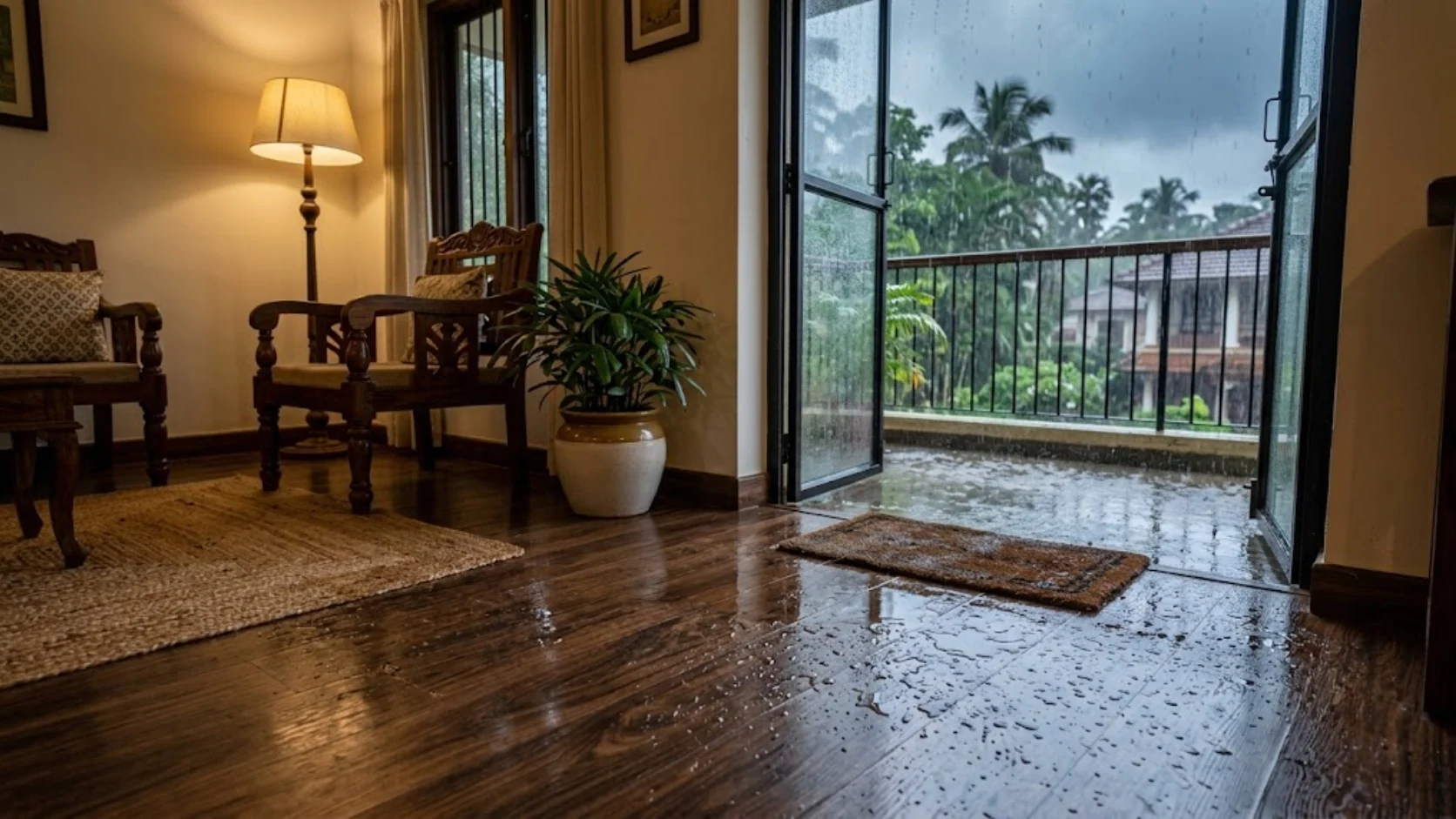
Monsoon season brings a familiar anxiety to Indian homeowners: will this year’s rain ruin the floor I just invested in? If you’ve searched for waterproof wood flooring, chances are you’ve already seen a warped skirting board, a cupped plank, or heard a horror story from a neighbor whose beautiful wooden flooring turned into a rippled mess by August.
It’s a fair worry. India isn’t dealing with occasional dampness — cities like Mumbai, Kochi, Chennai, and Kolkata see sustained humidity of 80-95% for weeks at a stretch. That kind of moisture exposure is exactly what traditional timber struggles with, and it’s why so many buyers are now exploring vinyl plank flooring, luxury vinyl flooring, and SPC-core alternatives instead of solid wood.
But here’s where it gets confusing: not every product marketed as “waterproof” actually performs that way once monsoon hits. Some premium wooden flooring options labeled wood-look or moisture-resistant still swell, gap, or warp under real-world humidity — because what’s inside the plank matters far more than what’s printed on the packaging.
This guide breaks down exactly what happens to different flooring types during Indian monsoons, what actually makes a floor waterproof (not just water-resistant), and how to choose confidently whether you’re flooring a ground-floor apartment in Goa or a high-rise in Bengaluru. We’ll also compare vinyl flooring against solid and engineered wood, cover installation and maintenance specifics for humid climates, and flag the common mistakes buyers make so you don’t have to learn them the hard way.
True waterproof wood flooring — specifically SPC and WPC-core luxury vinyl flooring — does not swell or warp in the Indian monsoon because its core is made from stone or wood-plastic composite, not real timber. However, solid wooden flooring and poorly sealed engineered wood can absorb humidity, causing gaps, cupping, or swelling during high-moisture months (June–September) in cities like Mumbai, Kochi, Chennai, and Kolkata. For genuine monsoon-proof performance, choose 100% waterproof vinyl plank flooring or SPC flooring with a certified waterproof rating rather than assuming all “wood-look” floors behave the same way.
Why This Question Matters for Indian Homebuyers
If you’ve ever walked into a home during July and noticed floorboards lifting at the edges or doors suddenly sticking, you already know what humidity does to timber. India’s monsoon isn’t a light drizzle — it’s 80-95% relative humidity sustained for weeks, sometimes months, depending on your region.
For anyone shopping for premium wooden flooring, this raises a legitimate concern: does “waterproof” flooring actually hold up, or is it just clever marketing? At OAKA Floors, we get this question from buyers in Mumbai, Bengaluru, Goa, and coastal Kerala more than almost any other — and the honest answer depends entirely on what’s inside the plank, not just what’s printed on the box.
Does Waterproof Wood Flooring Really Swell or Warp?
Short answer: Genuine waterproof flooring does not swell or warp. Wood-look flooring that isn’t truly waterproof can.
The confusion happens because “wood flooring,” “wood-look flooring,” and “waterproof wood flooring” get used interchangeably in the Indian market — but they are structurally different products.
| Flooring Type | Core Material | Swells in Monsoon? | Warps in Monsoon? |
|---|---|---|---|
| Solid Wooden Flooring | 100% natural timber | Yes, significantly | Yes |
| Engineered Wood Flooring | Plywood + real wood veneer | Sometimes (if unsealed edges) | Occasionally |
| Vinyl Plank Flooring (SPC core) | Stone Plastic Composite | No | No |
| Vinyl Flooring (WPC core) | Wood Plastic Composite | Minimal, if any | Rare |
| Laminate Flooring (non-waterproof) | HDF (compressed wood fiber) | Yes | Yes |
Key takeaway: If monsoon resilience is your top priority, SPC-core luxury vinyl flooring is currently the most dependable waterproof flooring for Indian homes.
Why Solid & Engineered Wood React to Monsoon Humidity
Real wood is hygroscopic — it absorbs and releases moisture from the surrounding air, regardless of how well it’s finished. This isn’t a manufacturing flaw; it’s simply how organic material behaves.
What happens during monsoon months:
- Swelling — Wood fibers absorb ambient moisture, causing planks to expand at the joints, resulting in a “tenting” or peaked appearance.
- Cupping — The edges of each plank rise higher than the center, usually from moisture entering the underside.
- Warping — Uneven moisture absorption across the plank causes it to twist or bow.
- Gapping — Once humidity drops post-monsoon, the wood contracts, leaving visible gaps between planks.
This is why buyers researching oak flooring or other premium wood species for coastal or high-humidity cities should budget for expansion gaps, proper acclimatization, and, ideally, climate-controlled installation — or consider a waterproof alternative altogether.
What Actually Makes Flooring “Waterproof”
Not all products labeled waterproof meet the same standard. Here’s what to check before buying:
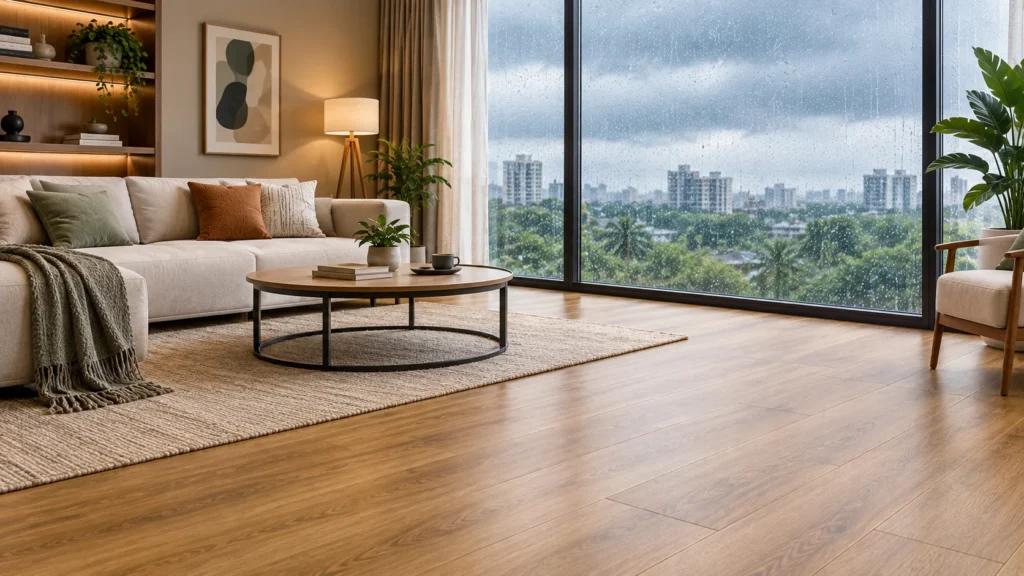
1. Core Material
SPC (Stone Plastic Composite) and WPC (Wood Plastic Composite) cores contain no organic wood fibers, so there’s nothing for moisture to swell.
2. Locking System
A tight, click-lock joining system prevents water from seeping between planks and reaching the subfloor.
3. Surface Sealing
A well-sealed wear layer stops surface water from penetrating, which matters during monsoon mopping and humidity spikes.
4. Certification
Look for IS (Indian Standard) compliance or international certifications (like European EN 13329) that specifically test water resistance — not just “water-resistant” marketing language.
Vinyl Plank Flooring vs Solid Wood: Monsoon Performance Comparison
| Factor | Vinyl Plank / SPC Flooring | Solid Wooden Flooring |
|---|---|---|
| Moisture Resistance | 100% waterproof core | Absorbs humidity |
| Swelling Risk in Monsoon | None | High |
| Warping Risk | None | Moderate to high |
| Maintenance in Humid Climate | Low — wipe and mop | High — needs dehumidifying, polishing |
| Lifespan in Coastal Cities | 15–25 years | Reduced without climate control |
| Cost | Mid-range | Premium |
| Look & Feel | Realistic wood-look finish | Authentic natural wood |
| Best Suited For | Humid & coastal Indian cities | Dry climate regions with controlled humidity |
For buyers in Mumbai, Chennai, Kochi, Goa, and the Northeast — where monsoon humidity is intense and prolonged — vinyl plank flooring consistently outperforms solid wood on durability without compromising the wood-look aesthetic people want.
Best Flooring for Humid Climate: What to Actually Look For
If you’re renovating or building in a best flooring for humid climate search mindset, prioritize these features:
- SPC or WPC core — non-porous, doesn’t expand with moisture
- IP or waterproof rating clearly mentioned by the manufacturer
- Click-lock installation — tighter seams, less water ingress
- UV-resistant wear layer — prevents fading from monsoon-adjacent heat and sun cycles
- Underlayment with moisture barrier — critical for ground-floor and basement installations
This is precisely why monsoon-proof flooring buyers are shifting toward engineered composite options rather than traditional timber, especially in apartments and homes without central climate control.
Installation Considerations for Monsoon-Prone Regions
Even the best waterproof wood flooring can underperform if installed incorrectly. A few things matter more in humid climates:
- Subfloor moisture testing — Always test subfloor moisture levels before installation, especially on ground floors.
- Acclimatization period — Let planks adjust to room temperature and humidity for 24–48 hours before laying, even with waterproof products.
- Expansion gaps — Leave the manufacturer-recommended gap along walls, even for SPC flooring, to allow for minor thermal movement.
- Professional installation — DIY installation increases the risk of poor seam sealing, which can let moisture in despite a waterproof core.
Maintenance Tips for Monsoon Season
- Wipe up standing water immediately — even waterproof floors shouldn’t sit under puddles for extended periods.
- Use a slightly damp (not wet) mop; avoid steam cleaners on click-lock flooring.
- Keep indoor humidity between 40-60% using a dehumidifier if your home tends toward 80%+ during monsoon.
- Place moisture-absorbing mats at entryways to reduce tracked-in rainwater.
- Check skirting and edges periodically for any water pooling near walls or balcony doors.
Common Mistakes Indian Buyers Make
- Assuming all “wood-look” flooring is waterproof — always confirm the core material, not just the surface finish.
- Skipping the underlayment — a cheap or missing moisture barrier undermines even a waterproof product.
- Ignoring subfloor prep — installing over a damp or uneven subfloor causes problems regardless of flooring type.
- Choosing based on showroom lighting alone — always ask for humidity/water-resistance test data, not just visual samples.
- Buying premium wooden flooring for a ground-floor coastal home without climate control — a mismatch between product and environment.
Pros & Cons Summary
Waterproof Vinyl / SPC Flooring
- ✅ True monsoon resistance, no swelling or warping
- ✅ Low maintenance, budget-friendly vs. solid wood
- ✅ Realistic wood-look finishes now closely mimic oak, walnut, teak
- ❌ Doesn’t have the exact tactile feel of natural wood
- ❌ Quality varies widely between brands — verification is essential
Solid/Engineered Wooden Flooring
- ✅ Authentic natural material, timeless aesthetic
- ✅ Can be sanded and refinished over time
- ❌ Vulnerable to monsoon humidity without climate control
- ❌ Higher long-term maintenance in humid Indian cities
How OAKA Floors Approaches Monsoon-Ready Flooring
At OAKA Floors, our waterproof wood flooring range is engineered specifically with Indian climate conditions in mind — combining SPC and WPC core technology with wood-look finishes inspired by oak, walnut, and teak. As one of the best wooden flooring brands catering to India’s humidity extremes, we test our vinyl plank and vinyl flooring lines against real monsoon conditions, not just lab-controlled environments, so buyers in coastal and high-humidity regions get a floor that performs as promised — season after season.
Conclusion
Not all wood-look flooring is created equal — and in India’s monsoon climate, that distinction matters more than most buyers realize. Solid and engineered wood can swell, cup, or warp under sustained humidity, while genuinely waterproof options like SPC and WPC-core vinyl plank flooring hold their shape and finish through even the heaviest monsoon months.
If you’re planning a renovation ahead of this monsoon season, it’s worth getting your space assessed before choosing a flooring type. Explore OAKA Floors’ waterproof flooring collection or reach out for a consultation tailored to your city’s climate and your home’s layout.
FAQ Section
Q1. Is waterproof wood flooring actually 100% waterproof?
Genuine SPC or WPC-core waterproof flooring is fully resistant to moisture absorption and won’t swell from humidity or spills. However, “100% waterproof” refers to the plank material — standing water should still be wiped up to protect seams and subflooring long-term.
Q2. Can I install waterproof vinyl flooring in a bathroom or balcony?
Yes. Waterproof vinyl plank flooring with a tight click-lock system is suitable for bathrooms, balconies, and other high-moisture areas, provided installation includes proper edge sealing.
Q3. Is engineered wood flooring safe for Indian monsoons?
Engineered wood performs better than solid wood but isn’t fully waterproof. It can still be affected by prolonged humidity exposure if not properly sealed and maintained.
Q4. What’s the difference between waterproof and water-resistant flooring?
Water-resistant flooring can tolerate brief moisture exposure but may be damaged by prolonged contact. Waterproof flooring, like SPC-core vinyl, withstands continuous moisture without structural damage.
Q5. Which is better for humid Indian climates — vinyl or wooden flooring?
For humidity-heavy regions and monsoon-prone cities, vinyl plank and SPC flooring are generally more reliable than solid wood, offering similar aesthetics with significantly better moisture resistance.
Q6. Does waterproof flooring smell or develop mold in monsoon?
No, quality SPC/WPC flooring is non-porous and doesn’t retain moisture, which prevents the mold and mildew growth commonly seen with untreated wood in humid conditions.